Set up the equation \( \tan(\alpha) = \frac{1}{\tan(\alpha + 10^\circ)} \).
Multiply both sides by \( \tan(\alpha + 10^\circ) \) to eliminate the fraction: \( \tan(\alpha) \cdot \tan(\alpha + 10^\circ) = 1 \).
Use the identity \( \tan(A) \cdot \tan(B) = 1 \) when \( A + B = 90^\circ \). Therefore, set \( \alpha + (\alpha + 10^\circ) = 90^\circ \).
Solve the equation \( 2\alpha + 10^\circ = 90^\circ \) to find the value of \( \alpha \).
Verified video answer for a similar problem:
This video solution was recommended by our tutors as helpful for the problem above
Play a video:
0 Comments
Key Concepts
Here are the essential concepts you must grasp in order to answer the question correctly.
Tangent and Cotangent Functions
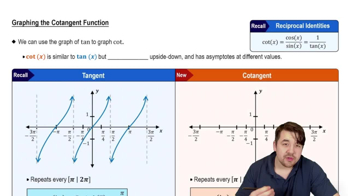
The tangent function, tan(α), is defined as the ratio of the opposite side to the adjacent side in a right triangle. The cotangent function, cot(α), is the reciprocal of tangent, expressed as cot(α) = 1/tan(α). Understanding the relationship between these two functions is crucial for solving equations involving them, especially when angles are transformed.
Angle addition formulas are used to express trigonometric functions of the sum of two angles in terms of the functions of the individual angles. For example, cot(α + 10°) can be expressed using cotangent and tangent identities. This concept is essential for simplifying and solving equations that involve angles added together.
Acute angles are angles that measure less than 90 degrees. In trigonometry, the values of sine, cosine, tangent, and their reciprocals are all positive for acute angles. This property is important when solving equations, as it restricts the possible solutions and ensures that the angles involved remain within the defined range.