Write each function in terms of its cofunction. Assume all angles involved are acute angles. See Example 2. cos(θ + 20°)
Table of contents
- 0. Review of College Algebra4h 45m
- 1. Measuring Angles40m
- 2. Trigonometric Functions on Right Triangles2h 5m
- 3. Unit Circle1h 19m
- 4. Graphing Trigonometric Functions1h 19m
- 5. Inverse Trigonometric Functions and Basic Trigonometric Equations1h 41m
- 6. Trigonometric Identities and More Equations2h 34m
- 7. Non-Right Triangles1h 38m
- 8. Vectors2h 25m
- 9. Polar Equations2h 5m
- 10. Parametric Equations1h 6m
- 11. Graphing Complex Numbers1h 7m
3. Unit Circle
Defining the Unit Circle
Problem 38
Textbook Question
Find one solution for each equation. Assume all angles involved are acute angles. See Example 3. cos(2θ + 50°) = sin(2θ - 20°)
Verified step by step guidance1
Recall the co-function identity in trigonometry: \(\sin x = \cos(90^\circ - x)\). Use this to rewrite the right side of the equation \(\cos(2\theta + 50^\circ) = \sin(2\theta - 20^\circ)\) as \(\cos(90^\circ - (2\theta - 20^\circ))\).
Simplify the expression inside the cosine on the right side: \(90^\circ - (2\theta - 20^\circ) = 90^\circ - 2\theta + 20^\circ = 110^\circ - 2\theta\).
Now the equation becomes \(\cos(2\theta + 50^\circ) = \cos(110^\circ - 2\theta)\). Since the cosines of two angles are equal, set the angles equal to each other or their supplements: either \(2\theta + 50^\circ = 110^\circ - 2\theta\) or \(2\theta + 50^\circ = 360^\circ - (110^\circ - 2\theta)\).
Solve the first equation \(2\theta + 50^\circ = 110^\circ - 2\theta\) for \(\theta\) by isolating \(\theta\) on one side.
Check the solution to ensure \(\theta\) is an acute angle (between \(0^\circ\) and \(90^\circ\)). If it is, this is a valid solution. If not, solve the second equation and check again.
Verified video answer for a similar problem:This video solution was recommended by our tutors as helpful for the problem above
Play a video:
0 Comments
Key Concepts
Here are the essential concepts you must grasp in order to answer the question correctly.
Trigonometric Identities
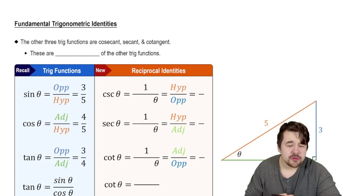
Trigonometric identities are equations involving trigonometric functions that hold true for all values within their domains. In this problem, recognizing that sin(x) = cos(90° - x) allows us to rewrite and equate angles, facilitating the solution of the equation.
Recommended video:
Fundamental Trigonometric Identities
Solving Trigonometric Equations
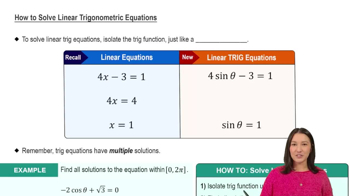
Solving trigonometric equations involves manipulating the equation using identities and algebraic techniques to isolate the variable. Since the problem restricts angles to acute values, solutions must be checked within the interval (0°, 90°) to ensure validity.
Recommended video:
How to Solve Linear Trigonometric Equations
Angle Restrictions and Domain Considerations
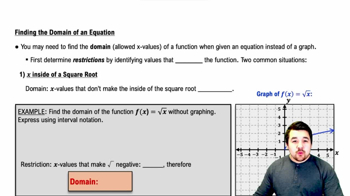
The problem specifies that all angles are acute, meaning between 0° and 90°. This restriction limits possible solutions and helps avoid extraneous answers that arise from the periodic nature of trigonometric functions.
Recommended video:
Finding the Domain of an Equation
Related Videos
Related Practice
Textbook Question
640
views