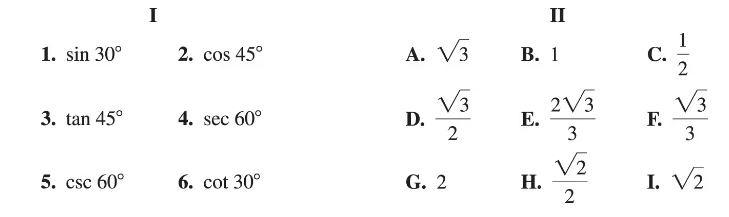
CONCEPT PREVIEW Match each trigonometric function in Column I with its value in Column II. Choices may be used once, more than once, or not at all. I II1. A. √32. B. 13. tan 45° C. ½4. D. √35. 26. E. 2√3 3 F. √3 3 G. 2 H. √2 2 I. √2
Verified step by step guidance
1
Step 1: Identify the trigonometric function given in Column I. In this case, it is tan 45°.
Step 2: Recall the basic trigonometric values. For tan 45°, the value is known to be 1.
Step 3: Match the value of tan 45° with the options in Column II.
Step 4: Find the option in Column II that corresponds to the value 1.
Step 5: Conclude that tan 45° matches with option B in Column II.
Verified video answer for a similar problem:
This video solution was recommended by our tutors as helpful for the problem above
Video duration:
3m
Play a video:
0 Comments
Key Concepts
Here are the essential concepts you must grasp in order to answer the question correctly.
Trigonometric Functions
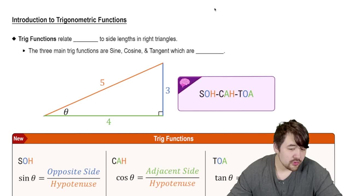
Trigonometric functions relate the angles of a triangle to the lengths of its sides. The primary functions include sine (sin), cosine (cos), and tangent (tan), which are defined for a right triangle as the ratios of the lengths of the opposite side to the hypotenuse, adjacent side to the hypotenuse, and opposite side to the adjacent side, respectively. Understanding these functions is essential for solving problems involving angles and side lengths.
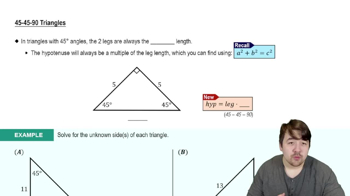
Certain angles, such as 0°, 30°, 45°, 60°, and 90°, have known values for their trigonometric functions, often referred to as special angles. For example, tan 45° equals 1, and sin 30° equals ½. Familiarity with these values allows for quick calculations and is crucial for matching functions to their corresponding values in problems like the one presented.
The unit circle is a circle with a radius of one centered at the origin of a coordinate plane. It provides a geometric interpretation of trigonometric functions, where the x-coordinate represents the cosine and the y-coordinate represents the sine of an angle. Understanding the unit circle helps in determining the values of trigonometric functions for various angles, facilitating the matching process in the given question.