Determine whether each statement is true or false. See Example 4.cos 28° < sin 28°(Hint: sin 28° = cos 62°)
Verified step by step guidance
1
Step 1: Understand the hint provided. The hint states that \( \sin 28^\circ = \cos 62^\circ \). This is based on the co-function identity \( \sin \theta = \cos (90^\circ - \theta) \).
Step 2: Recognize that the problem is asking to compare \( \cos 28^\circ \) and \( \sin 28^\circ \).
Step 3: Use the co-function identity to rewrite \( \sin 28^\circ \) as \( \cos 62^\circ \).
Step 4: Compare \( \cos 28^\circ \) and \( \cos 62^\circ \). Since \( 28^\circ < 62^\circ \), and cosine is a decreasing function in the first quadrant, \( \cos 28^\circ > \cos 62^\circ \).
Step 5: Conclude that \( \cos 28^\circ > \sin 28^\circ \), so the statement \( \cos 28^\circ < \sin 28^\circ \) is false.
Verified video answer for a similar problem:
This video solution was recommended by our tutors as helpful for the problem above
Video duration:
2m
Play a video:
0 Comments
Key Concepts
Here are the essential concepts you must grasp in order to answer the question correctly.
Trigonometric Ratios
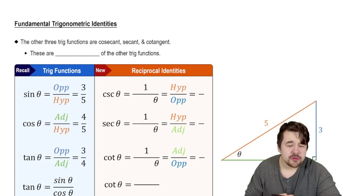
Trigonometric ratios are the relationships between the angles and sides of a right triangle. The primary ratios are sine (sin), cosine (cos), and tangent (tan), which are defined as the ratios of the lengths of the sides of the triangle. For example, sin(θ) is the ratio of the opposite side to the hypotenuse, while cos(θ) is the ratio of the adjacent side to the hypotenuse.
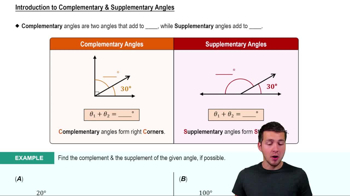
Complementary angles are two angles whose measures add up to 90 degrees. In trigonometry, this relationship leads to the identity sin(θ) = cos(90° - θ). This means that the sine of an angle is equal to the cosine of its complement, which is crucial for comparing values of sine and cosine for specific angles.
Inequalities in trigonometry involve comparing the values of trigonometric functions. Understanding how the sine and cosine functions behave within the range of 0° to 90° is essential, as sine increases while cosine decreases in this interval. This knowledge helps in determining the truth of statements involving these functions, such as whether cos(28°) is less than sin(28°).