Determine whether each statement is true or false. If false, tell why. csc 22° ≤ csc 68°
Verified step by step guidance
1
Recall the definition of the cosecant function: \(\csc \theta = \frac{1}{\sin \theta}\). This means that the value of \(\csc \theta\) depends inversely on \(\sin \theta\).
Since \(\sin \theta\) is positive in the first quadrant (where both 22° and 68° lie), compare \(\sin 22^\circ\) and \(\sin 68^\circ\) to understand the behavior of their cosecants.
Note that \(\sin 22^\circ\) is less than \(\sin 68^\circ\) because sine increases from 0° to 90°, so \(\sin 22^\circ < \sin 68^\circ\).
Because \(\csc \theta = \frac{1}{\sin \theta}\), a smaller sine value corresponds to a larger cosecant value. Therefore, \(\csc 22^\circ > \csc 68^\circ\).
Conclude that the statement \(\csc 22^\circ \leq \csc 68^\circ\) is false, since \(\csc 22^\circ\) is actually greater than \(\csc 68^\circ\).
Verified video answer for a similar problem:
This video solution was recommended by our tutors as helpful for the problem above
Video duration:
2m
Play a video:
0 Comments
Key Concepts
Here are the essential concepts you must grasp in order to answer the question correctly.
Definition and Properties of the Cosecant Function
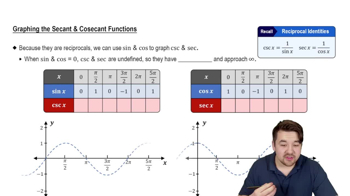
The cosecant function, csc(θ), is the reciprocal of the sine function, defined as csc(θ) = 1/sin(θ). It is important to understand that csc(θ) is undefined when sin(θ) = 0 and that its values depend inversely on the sine values.
Behavior of the Sine Function in the First Quadrant
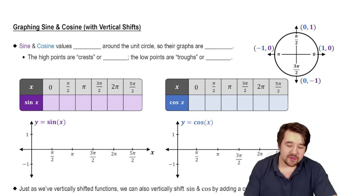
In the first quadrant (0° to 90°), the sine function increases as the angle increases. Therefore, sin(22°) < sin(68°), which directly affects the values of their reciprocals, the cosecants.
When comparing reciprocal functions like cosecant, the inequality reverses relative to the sine values. Since csc(θ) = 1/sin(θ), if sin(22°) < sin(68°), then csc(22°) > csc(68°), which is crucial for determining the truth of the given inequality.

 2:35 minutes
 Verified step by step guidance
 6:22
6:22