Ch. 2 - Acute Angles and Right Triangles
Lial - Trigonometry 12th Edition
Lial12th EditionTrigonometryISBN: 9780136552161Not the one you use?Change textbook
Chapter 3, Problem 67

Concept Check Work each problem. Find the equation of the line that passes through the origin and makes a 30° angle with the x-axis.

Verified step by step guidance
1
Recognize that the line passes through the origin, so its equation will be of the form \(y = mx\), where \(m\) is the slope of the line.
Recall that the slope \(m\) of a line making an angle \(\theta\) with the positive x-axis is given by \(m = \tan(\theta)\).
Substitute the given angle \(\theta = 30^\circ\) into the slope formula: \(m = \tan(30^\circ)\).
Use the known exact value or expression for \(\tan(30^\circ)\) to find the slope \(m\) (you do not need to calculate the decimal value, just express it).
Write the final equation of the line using the slope found: \(y = m x\), where \(m = \tan(30^\circ)\).

Verified video answer for a similar problem:

This video solution was recommended by our tutors as helpful for the problem above.
Was this helpful?

Key Concepts

Here are the essential concepts you must grasp in order to answer the question correctly.

Slope of a Line from an Angle

The slope of a line can be found using the tangent of the angle it makes with the positive x-axis. Specifically, slope m = tan(θ), where θ is the angle between the line and the x-axis. This relationship connects trigonometry with coordinate geometry.
Recommended video:
04:46
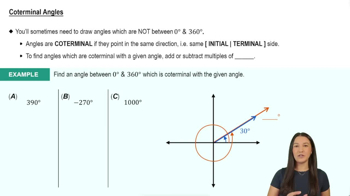
Coterminal Angles

Equation of a Line Through the Origin

A line passing through the origin (0,0) can be expressed as y = mx, where m is the slope. Since the line goes through the origin, there is no y-intercept term, simplifying the equation to a direct proportionality between y and x.
Recommended video:
08:02
Parameterizing Equations

Trigonometric Functions and Angle Measurement

Understanding how to use trigonometric functions like tangent requires knowing angle measurement in degrees or radians. Here, the angle is given as 30°, so converting or directly using tan(30°) helps find the slope accurately.
Recommended video:
6:04
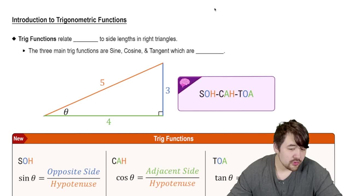
Introduction to Trigonometric Functions