
Ch 22: Gauss' Law
Young & Freedman Calc - University Physics 14th Edition
Young & Freedman Calc14th EditionUniversity PhysicsISBN: 9780321973610Not the one you use?Change textbook
Chapter 22, Problem 9a

A charged paint is spread in a very thin uniform layer over the surface of a plastic sphere of diameter 12.012.0 cm, giving it a charge of 49.0−49.0 μμC. Find the electric field just inside the paint layer.

Verified step by step guidance
1
Understand that the problem involves a uniformly charged sphere, and we need to find the electric field just inside the surface of the sphere.
Recall that for a uniformly charged spherical shell, the electric field inside the shell is zero. This is due to the symmetry of the charge distribution, as per Gauss's Law.
Apply Gauss's Law, which states that the electric flux through a closed surface is equal to the charge enclosed divided by the permittivity of free space: \( \Phi = \frac{Q}{\varepsilon_0} \).
Since the charge is only on the surface and we are considering a point just inside the surface, the enclosed charge is zero, leading to zero electric field inside.
Conclude that the electric field just inside the paint layer is zero, as the charges on the surface do not affect the field inside the sphere.

Verified video answer for a similar problem:

This video solution was recommended by our tutors as helpful for the problem above.
Video duration:
2m
Was this helpful?

Key Concepts

Here are the essential concepts you must grasp in order to answer the question correctly.

Electric Field

The electric field is a vector field around a charged object where a force would be exerted on other charges. It is defined as the force per unit charge and is measured in newtons per coulomb (N/C). For a spherical charge distribution, the electric field inside a conductor is zero, while outside, it behaves as if all the charge were concentrated at the center.
Recommended video:
Guided course
03:16
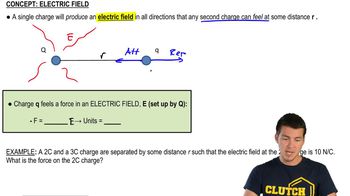
Intro to Electric Fields

Gauss's Law

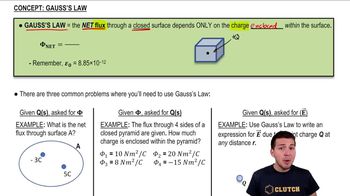
Gauss's Law relates the electric flux through a closed surface to the charge enclosed by that surface. It states that the total electric flux is equal to the enclosed charge divided by the permittivity of free space. This principle is particularly useful for calculating electric fields of symmetric charge distributions, such as spherical ones.
Recommended video:

Conductors in Electrostatic Equilibrium

In electrostatic equilibrium, the electric field inside a conductor is zero, and any excess charge resides on the surface. This is because charges redistribute themselves to cancel any internal electric fields. For a charged spherical conductor, the electric field just inside the surface is zero, as charges only affect the field outside the conductor.
Recommended video:
Guided course
07:43
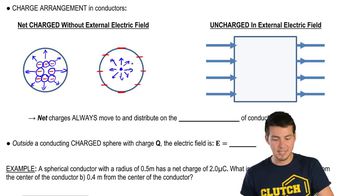
Electric Fields in Conductors
Related Practice
Textbook Question

A flat sheet of paper of area 0.2500.250 m2 is oriented so that the normal to the sheet is at an angle of 6060° to a uniform electric field of magnitude 1414 N/C. For what angle ϕ\(\phi\) between the normal to the sheet and the electric field is the magnitude of the flux through the sheet (i) largest and (ii) smallest? Explain your answers.

1972
views
1
rank
Textbook Question

The nuclei of large atoms, such as uranium, with 9292 protons, can be modeled as spherically symmetric spheres of charge. The radius of the uranium nucleus is approximately 7.4×10157.4\(\times\)10^{-15} m. The electrons can be modeled as forming a uniform shell of negative charge. What net electric field do they produce at the location of the nucleus?

3138
views
Textbook Question

The nuclei of large atoms, such as uranium, with 9292 protons, can be modeled as spherically symmetric spheres of charge. The radius of the uranium nucleus is approximately 7.4×10157.4\(\times\)10^{-15} m. What is the electric field this nucleus produces just outside its surface?

1740
views
1
rank
Textbook Question

You measure an electric field of 1.25×1061.25\(\times\)10^6 N/C at a distance of 0.1500.150 m from a point charge. There is no other source of electric field in the region other than this point charge.

(a) What is the electric flux through the surface of a sphere that has this charge at its center and that has radius 0.1500.150 m?

(b) What is the magnitude of this charge?

3788
views
Textbook Question

A hemispherical surface with radius rr in a region of uniform electric field E\(\overrightarrow{E}\) has its axis aligned parallel to the direction of the field. Calculate the flux through the surface.

3370
views
Textbook Question

A charged paint is spread in a very thin uniform layer over the surface of a plastic sphere of diameter 12.012.0 cm, giving it a charge of 49.0−49.0 μμC. Find the electric field just outside the paint layer;

1947
views