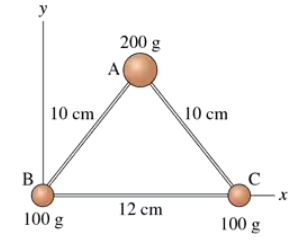
The three 200 g masses in FIGURE EX12.11 are connected by massless, rigid rods. What is the triangle's kinetic energy if it rotates about the axis at 5.0 rev/s?
Ch 12: Rotation of a Rigid Body
Knight Calc5th EditionPhysics for Scientists and EngineersISBN: 9780137344796Not the one you use?Change textbook
Chapter 12, Problem 15a
The three masses shown in FIGURE EX12.15 are connected by massless, rigid rods. Find the coordinates of the center of mass.

Verified step by step guidance1
Step 1: Understand the problem. The goal is to find the coordinates of the center of mass for the system of four masses connected by massless, rigid rods. The center of mass is calculated using the weighted average of the positions of the masses.
Step 2: Assign coordinates to each mass based on the diagram. For example: A (0, 0), B (12 cm, 0), C (12 cm, 6 cm), and D (0, 6 cm). These coordinates are derived from the given distances in the diagram.
Step 3: Use the formula for the x-coordinate of the center of mass: \( x_{\text{cm}} = \frac{\sum m_i x_i}{\sum m_i} \), where \( m_i \) is the mass of each object and \( x_i \) is its x-coordinate. Substitute the values: \( x_{\text{cm}} = \frac{(200 \times 0) + (400 \times 12) + (100 \times 12) + (400 \times 0)}{200 + 400 + 100 + 400} \).
Step 4: Use the formula for the y-coordinate of the center of mass: \( y_{\text{cm}} = \frac{\sum m_i y_i}{\sum m_i} \), where \( m_i \) is the mass of each object and \( y_i \) is its y-coordinate. Substitute the values: \( y_{\text{cm}} = \frac{(200 \times 0) + (400 \times 0) + (100 \times 6) + (400 \times 6)}{200 + 400 + 100 + 400} \).
Step 5: Simplify both expressions for \( x_{\text{cm}} \) and \( y_{\text{cm}} \) to find the coordinates of the center of mass. The final coordinates will be \( (x_{\text{cm}}, y_{\text{cm}}) \).

Verified video answer for a similar problem:
This video solution was recommended by our tutors as helpful for the problem above.
Video duration:
9mWas this helpful?
Key Concepts
Here are the essential concepts you must grasp in order to answer the question correctly.
Center of Mass
The center of mass of a system is the point where the total mass of the system can be considered to be concentrated. It is calculated by taking the weighted average of the positions of all masses in the system, factoring in their respective masses. The coordinates of the center of mass can be found using the formula: x_cm = (Σ(m_i * x_i)) / Σm_i and y_cm = (Σ(m_i * y_i)) / Σm_i, where m_i is the mass and (x_i, y_i) are the coordinates of each mass.
Recommended video:
Guided course
Intro to Center of Mass
Mass Distribution
Mass distribution refers to how mass is spread out in a system. In this problem, the masses are located at specific points (A, B, C, D) with given weights. Understanding how these masses are arranged in relation to each other is crucial for calculating the center of mass, as it directly influences the resulting coordinates based on their distances and magnitudes.
Recommended video:
Guided course
Moment of Inertia & Mass Distribution
Coordinate System
A coordinate system provides a framework for locating points in space using numerical values. In this problem, a two-dimensional Cartesian coordinate system is used, where positions are defined by x (horizontal) and y (vertical) coordinates. This system is essential for determining the positions of the masses and subsequently calculating the center of mass by applying the appropriate formulas.
Recommended video:
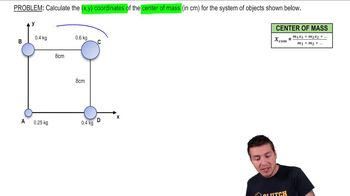
Guided course
Coordinates of Center of Mass of 4 objects
Related Practice
Textbook Question
2156
views
Textbook Question
A 25 kg solid door is 220 cm tall, 91 cm wide. What is the door's moment of inertia for rotation on its hinges?
1531
views
2
comments
Textbook Question
A 25 kg solid door is 220 cm tall, 91 cm wide. What is the door’s moment of inertia for rotation about a vertical axis inside the door, 15 cm from one edge?
1368
views
Textbook Question
The four masses shown in FIGURE EX12.13 are connected by massless, rigid rods. Find the coordinates of the center of mass.
1747
views
Textbook Question
The four masses shown in FIGURE EX12.13 are connected by massless, rigid rods. Find the moment of inertia about a diagonal axis that passes through masses B and D.
3636
views
Textbook Question
The three masses shown in FIGURE EX12.15 are connected by massless, rigid rods. Find the moment of inertia about an axis that passes through mass A and is perpendicular to the page.
3431
views