Ch 18: A Macroscopic Description of Matter
Knight Calc - Physics for Scientists and Engineers 5th Edition
Knight Calc5th EditionPhysics for Scientists and EngineersISBN: 9780137344796Not the one you use?Change textbook
Chapter 18, Problem 28b

A gas with initial state variables p1, V1, and T1 expands isothermally until V2 = 2V1. What are p2?

Verified step by step guidance
1
Step 1: Recognize that the process is isothermal, meaning the temperature (T) remains constant throughout the expansion. For an ideal gas undergoing an isothermal process, the relationship between pressure (p) and volume (V) is given by Boyle's Law: pV1 = p2V2.
Step 2: Substitute the given relationship for the final volume, V2 = 2V1, into Boyle's Law. This gives: pV1 = p2(2V1).
Step 3: Simplify the equation to solve for p2. Divide both sides of the equation by 2V1, resulting in: p2 = p12.
Step 4: Interpret the result. The final pressure p2 is half of the initial pressure p1, as the volume doubles during the isothermal expansion.
Step 5: Conclude that the temperature remains constant, and the relationship between pressure and volume is inversely proportional for an isothermal process. This is a direct application of Boyle's Law.

Verified video answer for a similar problem:

This video solution was recommended by our tutors as helpful for the problem above.
Video duration:
5m
Was this helpful?

Key Concepts

Here are the essential concepts you must grasp in order to answer the question correctly.

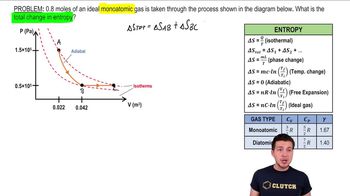
Isothermal Process

An isothermal process is a thermodynamic process in which the temperature remains constant. For an ideal gas, this means that any heat added to the system is used to do work, rather than increasing the internal energy. In this scenario, the relationship between pressure, volume, and temperature is governed by Boyle's Law, which states that pressure and volume are inversely related when temperature is constant.
Recommended video:
Guided course
06:13
Entropy & Ideal Gas Processes

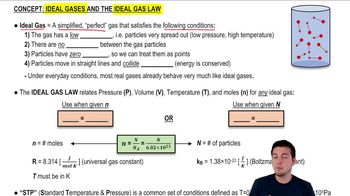
Ideal Gas Law

The Ideal Gas Law is a fundamental equation in thermodynamics that relates the pressure (p), volume (V), and temperature (T) of an ideal gas. It is expressed as PV = nRT, where n is the number of moles and R is the ideal gas constant. This law allows us to derive relationships between the state variables of a gas, particularly useful in determining the final pressure after an isothermal expansion.
Recommended video:
Guided course
07:21
Ideal Gases and the Ideal Gas Law

Boyle's Law

Boyle's Law states that for a given mass of gas at constant temperature, the pressure of the gas is inversely proportional to its volume. Mathematically, this is expressed as P₁V₁ = P₂V₂. In the context of the question, as the gas expands isothermally to double its volume, Boyle's Law can be used to calculate the new pressure, p₂, based on the initial conditions.
Recommended video: