
An airplane feels a lift force perpendicular to its wings. In level flight, the lift force points straight up and is equal in magnitude to the gravitational force on the plane. When an airplane turns, it banks by tilting its wings, as seen from behind, by an angle from horizontal. This causes the lift to have a radial component, similar to a car on a banked curve. If the lift had constant magnitude, the vertical component of would now be smaller than the gravitational force, and the plane would lose altitude while turning. However, you can assume that the pilot uses small adjustments to the plane's control surfaces so that the vertical component of continues to balance the gravitational force throughout the turn. Find an expression for the banking angle needed to turn in a circle of radius while flying at constant speed .

- Ch 01: Concepts of Motion35
- Ch 02: Kinematics in One Dimension75
- Ch 03: Vectors and Coordinate Systems58
- Ch 04: Kinematics in Two Dimensions60
- Ch 05: Force and Motion23
- Ch 06: Dynamics I: Motion Along a Line53
- Ch 07: Newton's Third Law27
- Ch 08: Dynamics II: Motion in a Plane52
- Ch 09: Work and Kinetic Energy56
- Ch 10: Interactions and Potential Energy50
- Ch 11: Impulse and Momentum56
- Ch 12: Rotation of a Rigid Body71
- Ch 13: Newton's Theory of Gravity52
- Ch 14: Fluids and Elasticity44
- Ch 15: Oscillations55
- Ch 16: Traveling Waves37
- Ch 17: Superposition39
- Ch 18: A Macroscopic Description of Matter53
- Ch 19: Work, Heat, and the First Law of Thermodynamics60
- Ch 20: The Micro/Macro Connection53
- Ch 21: Heat Engines and Refrigerators34
- Ch 22: Electric Charges and Forces40
- Ch 23: The Electric Field39
- Ch 24: Gauss' Law32
- Ch 25: The Electric Potential63
- Ch 26: Potential and Field57
- Ch 27: Current and Resistance42
- Ch 28: Fundamentals of Circuits39
- Ch 29: The Magnetic Field47
- Ch 30: Electromagnetic Induction60
- Ch 31: Electromagnetic Fields and Waves32
- Ch 32: AC Circuits63
- Ch 33: Wave Optics32
- Ch 34: Ray Optics57
- Ch 35: Optical Instruments30
- Ch 36: Special Relativity38
- Ch 37: The Foundations of Modern Physics25
- Ch 38: Quantization49
- Ch 39: Wave Functions and Uncertainty31
- Ch 40: One-Dimensional Quantum Mechanics35
- Ch 41: Atomic Physics18
- Ch 42: Nuclear Physics27
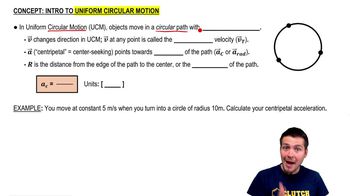
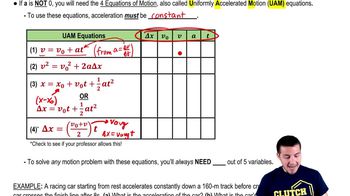
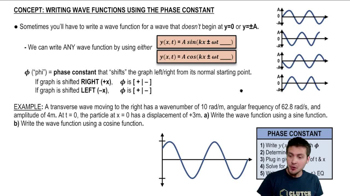
Scientists design a new particle accelerator in which protons (mass 1.7 X 10⁻²⁷ kg) follow a circular trajectory given by where c = 5.0 m and k = 8.0 x 10⁴ rad/s2 are constants and t is the elapsed time. What is the radius of the circle?
 Verified step by step guidance
Verified video answer for a similar problem:

Key Concepts
Circular Motion
 03:48
03:48
Parametric Equations
 08:25
08:25Constants in Motion
 08:59
08:59A 100 g ball on a 60-cm-long string is swung in a vertical circle about a point 200 cm above the floor. The string suddenly breaks when it is parallel to the ground and the ball is moving upward. The ball reaches a height 600 cm above the floor. What was the tension in the string an instant before it broke?
The physics of circular motion sets an upper limit to the speed of human walking. (If you need to go faster, your gait changes from a walk to a run.) If you take a few steps and watch what's happening, you'll see that your body pivots in circular motion over your forward foot as you bring your rear foot forward for the next step. As you do so, the normal force of the ground on your foot decreases and your body tries to 'lift off' from the ground. A person's center of mass is very near the hips, at the top of the legs. Model a person as a particle of mass m at the top of a leg of length L. Find an expression for the person's maximum walking speed vmax.
2.0 kg ball swings in a vertical circle on the end of an 80-cm-long string. The tension in the string is 20 N when its angle from the highest point on the circle is θ = 30°. What is the ball's speed when θ = 30°?
For safety, elevators have a rotational governor, a device that is attached to and rotates with one of the elevator's pulleys. The governor, shown in FIGURE P8.63, is a disk with two hollow channels holding springs with metal blocks of mass m attached to their free ends. The faster the governor spins, the more the springs stretch. At a critical angular velocity ωc, the metal blocks contact the housing, which completes a circuit and activates an emergency brake. The spring force on a mass, which we will explore more thoroughly in Chapter 9, is FSp = k(r - L), where k is the spring constant measured in N/m, and L is the relaxed (unstretched) length of the spring. Suppose a rotational governor has L = 0.80R and the emergency brake activates when the metal blocks reach r = R. What is the critical angular velocity in rpm if R = 15cm, k = 20 N/m, and m = 25g? Ignore gravity.
In the absence of air resistance, a projectile that lands at the elevation from which it was launched achieves maximum range when launched at a 45° angle. Suppose a projectile of mass m is launched with speed into a headwind that exerts a constant, horizontal retarding force . Find an expression for the angle at which the range is maximum.