
Ch 18: A Macroscopic Description of Matter
Knight Calc - Physics for Scientists and Engineers 5th Edition
Knight Calc5th EditionPhysics for Scientists and EngineersISBN: 9780137344796Not the one you use?Change textbook
Chapter 18, Problem 68a

In Problems 67,68,69,67, 68, 69, and 7070 you are given the equation(s) used to solve a problem. For each of these, you are to write a realistic problem for which this is the correct equation(s).
(T2+273) K=200 kPa500 kPa×1×(400+273) K(T_2 + 273) \(\text{ K}\) = \(\frac{200 \text{ kPa}\)}{500 \(\text{ kPa}\)} \(\times\) 1 \(\times\) (400 + 273) \(\text{ K}\)

Verified step by step guidance
1
Step 1: Recognize that the given equation is a form of the combined gas law, which relates the pressure, volume, and temperature of a gas. The combined gas law is expressed as: \( \frac{P_1 V_1}{T_1} = \frac{P_2 V_2}{T_2} \). In this case, the volume \( V \) is constant, so it simplifies to \( \frac{P_1}{T_1} = \frac{P_2}{T_2} \).
Step 2: Analyze the given equation: \( (T_2 + 273) \, \text{K} = \frac{200 \, \text{kPa}}{500 \, \text{kPa}} \times 1 \times (400 + 273) \text{K} \). This equation suggests that the problem involves a gas undergoing a change in pressure and temperature, with the volume held constant.
Step 3: Write a realistic problem based on the equation. For example: 'A gas is initially at a pressure of 500 kPa and a temperature of 400°C. The gas is then cooled while maintaining a constant volume, and its pressure decreases to 200 kPa. What is the final temperature of the gas in degrees Celsius?'
Step 4: Explain how the equation is used to solve the problem. The equation \( \frac{P_1}{T_1} = \frac{P_2}{T_2} \) is rearranged to solve for \( T_2 \): \( T_2 = \frac{P_2}{P_1} \times T_1 \). Here, \( T_1 \) is converted to Kelvin by adding 273 to the initial temperature in Celsius, and \( T_2 \) is converted back to Celsius after solving.
Step 5: Substitute the known values into the equation: \( T_2 + 273 = \frac{200}{500} \times (400 + 273) \). Simplify the expression to find \( T_2 \) in Kelvin, then subtract 273 to convert it to Celsius. This provides the final temperature of the gas after the pressure change.

Verified video answer for a similar problem:

This video solution was recommended by our tutors as helpful for the problem above.
Video duration:
6m
Was this helpful?

Key Concepts

Here are the essential concepts you must grasp in order to answer the question correctly.

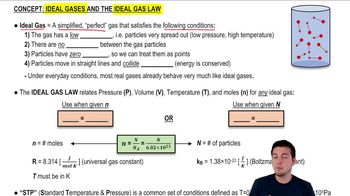
Ideal Gas Law

The Ideal Gas Law is a fundamental equation in thermodynamics that relates the pressure, volume, temperature, and number of moles of an ideal gas. It is expressed as PV = nRT, where P is pressure, V is volume, n is the number of moles, R is the ideal gas constant, and T is temperature in Kelvin. Understanding this law is crucial for solving problems involving gas behavior under varying conditions.
Recommended video:
Guided course
07:21
Ideal Gases and the Ideal Gas Law

Temperature Conversion

Temperature conversion is the process of changing a temperature value from one scale to another, such as Celsius to Kelvin. The Kelvin scale is an absolute temperature scale where 0 K is absolute zero, and it is calculated by adding 273.15 to the Celsius temperature. This conversion is essential in thermodynamic equations to ensure that temperature values are in the correct units for calculations.
Recommended video:
Guided course
07:46
Unit Conversions

Pressure Units

Pressure is defined as the force exerted per unit area and is commonly measured in units such as pascals (Pa), kilopascals (kPa), and atmospheres (atm). In the context of the given equation, understanding how to convert and compare different pressure units is vital for solving problems related to gas laws and thermodynamic processes. The relationship between pressure and temperature is key in determining the behavior of gases.
Recommended video:
Guided course
17:04
Pressure and Atmospheric Pressure
Related Practice
Textbook Question

An inflated bicycle inner tube is 2.2 cm in diameter and 200 cm in circumference. A small leak causes the gauge pressure to decrease from 110 psi to 80 psi on a day when the temperature is 20°C. What mass of air is lost? Assume the air is pure nitrogen.

1997
views
Textbook Question

The closed cylinder of FIGURE CP18.74 has a tight-fitting but frictionless piston of mass M. The piston is in equilibrium when the left chamber has pressure p₀ and length L₀ while the spring on the right is compressed by ΔL. Suppose the piston is moved a small distance x to the right. Find an expression for the net force (Fₓ)net on the piston. Assume all motions are slow enough for the gas to remain at the same temperature as its surroundings.

1817
views
Textbook Question

The cylinder in FIGURE CP18.73 has a moveable piston attached to a spring. The cylinder's cross-section area is 10 cm2, it contains 0.0040 mol of gas, and the spring constant is 1500 N/m. At 20°C the spring is neither compressed nor stretched. How far is the spring compressed if the gas temperature is raised to 100°C?

2406
views
Textbook Question

Five grams of nitrogen gas at an initial pressure of 3.0 atm and at 20°C undergo an isobaric expansion until the volume has tripled. What is the gas temperature after the expansion (in °C)? The gas pressure is then decreased at constant volume until the original temperature is reached.

1498
views
Textbook Question

In Problems 67,68,69,67, 68, 69, and 7070 you are given the equation(s) used to solve a problem. For each of these, you are to write a realistic problem for which this is the correct equation(s).

p2=300 cm3100 cm3×1×2 atmp_2 = \(\frac{300 \text{ cm}\)^3}{100 \(\text{ cm}\)^3} \(\times\) 1 \(\times\) 2 \(\text{ atm}\)

1776
views
Textbook Question

Five grams of nitrogen gas at an initial pressure of 3.0 atm and at 20°C undergo an isobaric expansion until the volume has tripled. What is the gas volume after the expansion?

1528
views