
Ch 03: Motion in Two or Three Dimensions
Young & Freedman Calc - University Physics 14th Edition
Young & Freedman Calc14th EditionUniversity PhysicsISBN: 9780321973610Not the one you use?Change textbook
Chapter 3, Problem 32

Two piers, A and B, are located on a river; B is 1500 m downstream from A (Fig. E3.32). Two friends must make round trips from pier A to pier B and return. One rows a boat at a constant speed of 4.00 km/h relative to the water; the other walks on the shore at a constant speed of 4.00 km/h. The velocity of the river is 2.80 km/h in the direction from A to B. How much time does it take each person to make the round trip?


Diagram showing piers A and B, with a boat and river current for relative velocity problem.

Verified step by step guidance
1
First, convert all speeds to the same unit. The rowing speed and walking speed are given as 4.00 km/h, and the river current speed is 2.80 km/h. Convert these speeds to meters per second: 1 km/h = 1000 m/3600 s, so 4.00 km/h = 4.00 * (1000/3600) m/s and 2.80 km/h = 2.80 * (1000/3600) m/s.
Calculate the effective speed of the boat when going downstream and upstream. Downstream, the boat's speed relative to the ground is the sum of its speed and the river's current speed. Upstream, the boat's speed relative to the ground is the difference between its speed and the river's current speed.
Determine the time taken for the boat to travel downstream and upstream. Use the formula for time: \( t = \frac{d}{v} \), where \( d \) is the distance and \( v \) is the speed. Calculate the time for downstream travel using the effective downstream speed and the time for upstream travel using the effective upstream speed.
Calculate the total time for the boat's round trip by adding the downstream and upstream travel times.
For the person walking, calculate the time taken for the round trip using the formula \( t = \frac{d}{v} \), where \( d \) is the total round trip distance (2 * 1500 m) and \( v \) is the walking speed in meters per second. Since the walking speed is constant and unaffected by the river current, this calculation is straightforward.

Verified video answer for a similar problem:

This video solution was recommended by our tutors as helpful for the problem above.
Video duration:
7m
Was this helpful?

Key Concepts

Here are the essential concepts you must grasp in order to answer the question correctly.

Relative Velocity

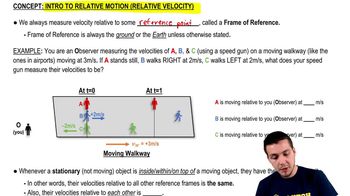
Relative velocity is the velocity of an object as observed from a particular reference frame. In this scenario, the boat's speed relative to the water and the river's current must be combined to determine the effective speed of the boat when moving downstream and upstream. Understanding how to calculate relative velocities is crucial for solving problems involving moving objects in different mediums.
Recommended video:
Guided course
04:27
Intro to Relative Motion (Relative Velocity)

Constant Speed

Constant speed refers to the unchanging speed of an object over time. In this problem, both the boat and the walker maintain constant speeds of 4.00 km/h. This concept simplifies the calculations for time taken to travel distances, as the time can be calculated using the formula time = distance/speed, allowing for straightforward comparisons between the two modes of travel.
Recommended video:
Guided course
08:59
Phase Constant of a Wave Function

Round Trip Calculation

A round trip involves traveling to a destination and returning to the starting point. In this case, the friends must calculate the total time taken for the boat to row from pier A to pier B and back, as well as the time for the walker. This requires summing the time for both the downstream and upstream journeys, taking into account the effects of the river current on the boat's speed.
Recommended video:
Guided course
08:10
Calculating the Vector (Cross) Product Using Components
Related Practice
Textbook Question

A railroad flatcar is traveling to the right at a speed of 13.0 m/s relative to an observer standing on the ground. Someone is riding a motor scooter on the flatcar (Fig. E3.30). What is the velocity (magnitude and direction) of the scooter relative to the flatcar if the scooter's velocity relative to the observer on the ground is 18.0 m/s to the right?

3000
views
Textbook Question

The nose of an ultralight plane is pointed due south, and its airspeed indicator shows 35 m/s35\(\text{ m/s}\). The plane is in a 10 m/s10\(\text{ m/s}\) wind blowing toward the southwest relative to the earth. Let xx be east and yy be north, and find the components of vP/E\(\overrightarrow{v}\)_{P/E} .

1914
views
Textbook Question

A 'moving sidewalk' in an airport terminal moves at 1.0 m/s and is 35.0 m long. If a woman steps on at one end and walks at 1.5 m/s relative to the moving sidewalk, how much time does it take her to reach the opposite end if she walks In the opposite direction?

2585
views
Textbook Question

A canoe has a velocity of 0.40 m/s southeast relative to the earth. The canoe is on a river that is flowing 0.50 m/s east relative to the earth. Find the velocity (magnitude and direction) of the canoe relative to the river.

3896
views
Textbook Question

The nose of an ultralight plane is pointed due south, and its airspeed indicator shows 35 m/s35\(\text{ m/s}\). The plane is in a 10 m/s10\(\text{ m/s}\) wind blowing toward the southwest relative to the earth. In a vector-addition diagram, show the relationship of vP/E\(\overrightarrow{v}\)_{P/E} (the velocity of the plane relative to the earth) to the two given vectors.

2699
views
Textbook Question

A 'moving sidewalk' in an airport terminal moves at 1.0 m/s and is 35.0 m long. If a woman steps on at one end and walks at 1.5 m/s relative to the moving sidewalk, how much time does it take her to reach the opposite end if she walks in the same direction the sidewalk is moving?

2204
views