
Ch 27: Magnetic Field and Magnetic Forces
Young & Freedman Calc - University Physics 14th Edition
Young & Freedman Calc14th EditionUniversity PhysicsISBN: 9780321973610Not the one you use?Change textbook
Chapter 27, Problem 10

A flat, square surface with side length 3.40cm3.40\(\operatorname{cm}\) is in the xy-plane at z=0z = 0. Calculate the magnitude of the flux through this surface produced by a magnetic field B=(0.200T)i+(0.300T)j(0.500T)kB=(0.200T)\(\mathbf{i}\)+(0.300T)\(\mathbf{j}\)-(0.500T)\(\mathbf{k}\).

Verified step by step guidance
1
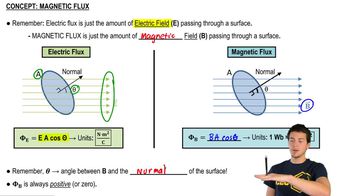
Understand the concept of magnetic flux: Magnetic flux (Φ) through a surface is given by the dot product of the magnetic field vector (B) and the area vector (A). The formula is Φ = B ⋅ A.
Determine the area vector: Since the surface is in the xy-plane, the area vector is perpendicular to the surface and points in the z-direction. The magnitude of the area vector is equal to the area of the surface, and its direction is along the positive z-axis. Therefore, A = (0, 0, A_z).
Calculate the area of the square surface: The side length of the square is 3.40 cm, which needs to be converted to meters for consistency in units. The area (A) of the square is given by A = side_length^2. Convert 3.40 cm to meters by dividing by 100.
Express the area vector: Since the surface is in the xy-plane, the area vector is A = (0, 0, A_z), where A_z is the area calculated in the previous step.
Calculate the dot product B ⋅ A: The magnetic field vector B is given as B = (0.200 T)i + (0.300 T)j - (0.500 T)k. The dot product B ⋅ A is calculated as B_x * A_x + B_y * A_y + B_z * A_z. Since A_x and A_y are zero, the dot product simplifies to B_z * A_z.

Verified video answer for a similar problem:

This video solution was recommended by our tutors as helpful for the problem above.
Video duration:
4m
Was this helpful?

Key Concepts

Here are the essential concepts you must grasp in order to answer the question correctly.

Magnetic Flux

Magnetic flux through a surface is a measure of the number of magnetic field lines passing through that surface. It is calculated as the dot product of the magnetic field vector and the area vector of the surface. The formula is Φ = B · A = B * A * cos(θ), where B is the magnetic field, A is the area, and θ is the angle between B and the normal to the surface.
Recommended video:
Guided course
04:52
Magnetic Flux

Dot Product

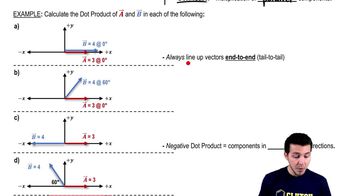
The dot product is a mathematical operation that takes two equal-length sequences of numbers (usually coordinate vectors) and returns a single number. In the context of magnetic flux, it is used to calculate the component of the magnetic field that is perpendicular to the surface. The dot product of vectors A and B is given by A · B = Ax * Bx + Ay * By + Az * Bz.
Recommended video:
Guided course
09:07
Introduction to Dot Product (Scalar Product)

Area Vector

The area vector is a vector that is perpendicular to a given surface and has a magnitude equal to the area of the surface. For a flat surface in the xy-plane, the area vector points in the z-direction. In this problem, the area vector A for the square surface is (0, 0, A), where A is the area of the square, calculated as side length squared.
Recommended video:
Guided course
04:05
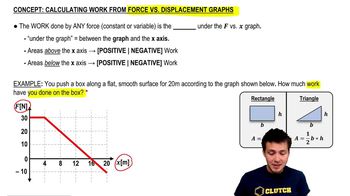
Calculating Work As Area Under F-x Graphs
Related Practice