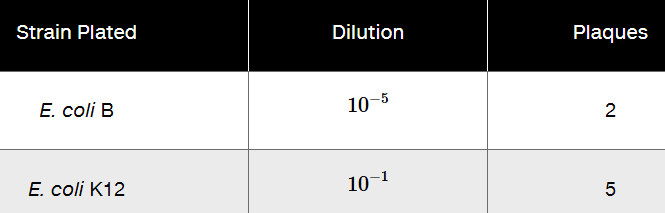
Using mutants 2 and 3 from Problem 19, following mixed infection on E. coli B, progeny viruses were plated in a series of dilutions on both E. coli B and K12 with the following results.
What is the recombination frequency between the two mutants?

Klug 12th Edition
Ch. 6 - Genetic Analysis and Mapping in Bacteria and Bacteriophages
Problem 20b
Verified step by step guidance
Using mutants 2 and 3 from Problem 19, following mixed infection on E. coli B, progeny viruses were plated in a series of dilutions on both E. coli B and K12 with the following results.
What is the recombination frequency between the two mutants?
In studies of recombination between mutants 1 and 2 from Problem 21, the results shown in the following table were obtained.
Calculate the recombination frequency.
During the analysis of seven rII mutations in phage T4, mutants 1, 2, and 6 were in cistron A, while mutants 3, 4, and 5 were in cistron B. Of these, mutant 4 was a deletion overlapping mutant 5. The remainder were point mutations. Nothing was known about mutant 7. Predict the results of complementation (+ or -) between 1 and 2; 1 and 3; 2 and 4; and 4 and 5.
In an analysis of rII mutants, complementation testing yielded the following results:
If further testing of the mutations in Problem 18 yielded the following results, what would you conclude about mutant 5?