Ch. 17 Blood
Marieb - Human Anatomy & Physiology 7th Edition
Marieb, Hoehn7th EditionHuman Anatomy & PhysiologyISBN: 9780805359091Not the one you use?Change textbook
Chapter 16, Problem 22

Discuss hemoglobin relative to its chemical structure, its function, and the color changes it undergoes during loading and unloading of oxygen.

Verified step by step guidance
1
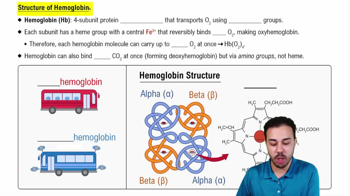
Start by describing the chemical structure of hemoglobin: it is a protein composed of four polypeptide chains (two alpha and two beta chains), each containing a heme group with an iron (Fe2+) atom at its center, which is essential for oxygen binding.
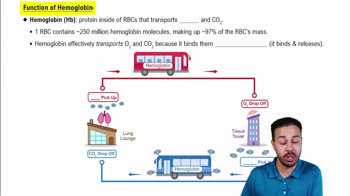
Explain the primary function of hemoglobin, which is to transport oxygen from the lungs to the tissues and facilitate the return transport of carbon dioxide from tissues to the lungs.
Discuss how oxygen binds reversibly to the iron atom in the heme group, allowing hemoglobin to pick up oxygen in the lungs (loading) and release it in the tissues (unloading).
Describe the color changes associated with hemoglobin: when oxygen is bound (oxyhemoglobin), the blood appears bright red; when oxygen is released (deoxyhemoglobin), the blood takes on a darker, bluish-red color.
Conclude by noting that these color changes are due to conformational changes in the hemoglobin molecule and the different light absorption properties of oxyhemoglobin versus deoxyhemoglobin.

Verified video answer for a similar problem:

This video solution was recommended by our tutors as helpful for the problem above.
Video duration:
2m
Was this helpful?

Key Concepts

Here are the essential concepts you must grasp in order to answer the question correctly.

Chemical Structure of Hemoglobin

Hemoglobin is a protein composed of four polypeptide chains, each containing a heme group with an iron atom. This iron binds oxygen molecules, enabling hemoglobin to carry oxygen in the blood. The quaternary structure allows cooperative binding, meaning oxygen binding to one subunit increases affinity in others.
Recommended video:
6:45
Structure of Hemoglobin

Function of Hemoglobin

Hemoglobin's primary function is to transport oxygen from the lungs to tissues and facilitate carbon dioxide return to the lungs. It binds oxygen in high-oxygen environments and releases it where oxygen is low, supporting cellular respiration and energy production.
Recommended video:
7:52
Function of Hemoglobin

Color Changes During Oxygen Loading and Unloading

Hemoglobin changes color based on its oxygenation state: oxygenated hemoglobin appears bright red due to oxygen binding, while deoxygenated hemoglobin is darker, giving venous blood a bluish tint. These color changes reflect structural shifts in the heme group during oxygen loading and unloading.
Recommended video:
Guided course
8:33
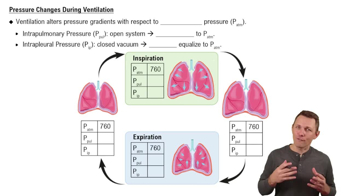
Pressure Changes During Ventilation
Related Practice
Textbook Question

Cancer patients being treated with chemotherapeutic drugs designed to destroy rapidly dividing cells are monitored closely for changes in their red and white blood counts. Why so?

1057
views
Textbook Question

Define hemostasis

List the three major phases of coagulation. Explain what initiates each phase and what the phase accomplishes

In what general way do the intrinsic and extrinsic mechanisms of clotting differ?

Which ion is essential to virtually all stages of coagulation?

1117
views
Textbook Question

How is clot overgrowth usually prevented?

List two conditions that may lead to unnecessary (and undesirable) clot formation.

707
views
Textbook Question

Alan Forsythe, a middle-aged college professor from Boston, is in the Swiss Alps studying astronomy during his sabbatical leave. He has been there for two days and plans to stay the entire year. However, he notices that he is short of breath when he walks up steps and tires easily with any physical activity. His symptoms gradually disappear, and he feels fine after less than a month. Upon returning to the United States, he has a complete physical exam and is told that his erythrocyte count is higher than normal.

a. Attempt to explain this finding.

b. Will his RBC count remain at this higher-than-normal level? Why or why not?

762
views
Textbook Question

Amanda Healy, a young woman with severe vaginal bleeding, is admitted to the emergency room. She is three months pregnant, and the physician is concerned about the volume of blood she is losing.

What type of transfusion will probably be given to this patient?

Which blood tests will be performed before starting the transfusion?

61
views
Textbook Question

How can poor nutrition lead to anemia?

761
views