Ch. 21 The Immune System: Innate and Adaptive Body Defenses
Marieb - Human Anatomy & Physiology 7th Edition
Marieb, Hoehn7th EditionHuman Anatomy & PhysiologyISBN: 9780805359091Not the one you use?Change textbook
Chapter 20, Problem 14

What is complement? How does it cause bacterial lysis? What are some of the other roles of complement?

Verified step by step guidance
1
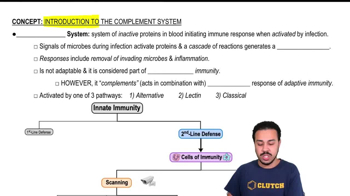
Understand that the complement system is a group of plasma proteins that work together to enhance the immune response, particularly by targeting pathogens like bacteria.
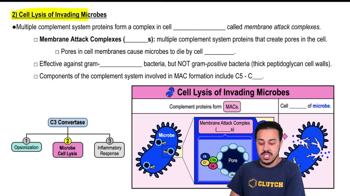
Learn that complement causes bacterial lysis primarily through the formation of the Membrane Attack Complex (MAC), which creates pores in the bacterial cell membrane, leading to cell rupture.
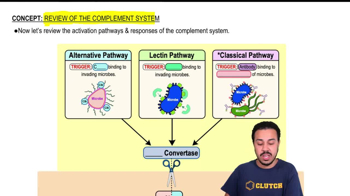
Recognize the sequence of complement activation pathways (classical, lectin, and alternative) that converge to activate the complement cascade and ultimately form the MAC.
Explore other roles of complement, such as opsonization, where complement proteins coat pathogens to enhance phagocytosis by immune cells.
Consider additional functions like promoting inflammation by attracting immune cells to the site of infection and clearing immune complexes and damaged cells from the body.

Verified video answer for a similar problem:

This video solution was recommended by our tutors as helpful for the problem above.
Video duration:
5m
Was this helpful?

Key Concepts

Here are the essential concepts you must grasp in order to answer the question correctly.

Complement System

The complement system is a group of proteins in the blood that work together to fight infections. It enhances the ability of antibodies and immune cells to clear microbes and damaged cells, promoting inflammation and attacking the pathogen's membrane.
Recommended video:
4:25
Complement System

Mechanism of Bacterial Lysis by Complement

Complement causes bacterial lysis primarily through the formation of the Membrane Attack Complex (MAC), which creates pores in the bacterial cell membrane. This disrupts the membrane integrity, leading to cell swelling and rupture, effectively killing the bacteria.
Recommended video:
3:18
Cell Lysis of Invading Microbes

Other Roles of Complement

Beyond bacterial lysis, complement aids in opsonization, marking pathogens for phagocytosis, and promotes inflammation by attracting immune cells to infection sites. It also helps clear immune complexes and apoptotic cells, maintaining immune system balance.
Recommended video:
5:15
Review of the Complement System