Ch. 25 The Urinary System
Marieb - Human Anatomy & Physiology 7th Edition
Marieb, Hoehn7th EditionHuman Anatomy & PhysiologyISBN: 9780805359091Not the one you use?Change textbook
Chapter 24, Problem 18

Trace the pathway a creatinine molecule takes from a glomerulus to the urethra. Name every microscopic or gross structure it passes through on its journey.

Verified step by step guidance
1
Start at the glomerulus, where creatinine is filtered from the blood into the Bowman's capsule. This is the initial step in urine formation.
Next, the filtrate containing creatinine enters the proximal convoluted tubule, where some reabsorption and secretion occur, but creatinine mostly remains in the filtrate.
From the proximal tubule, the filtrate flows into the loop of Henle, which has descending and ascending limbs that concentrate or dilute the filtrate.
After the loop of Henle, the filtrate moves into the distal convoluted tubule, where further regulation of ions and water occurs.
The filtrate then enters the collecting duct, which collects urine from multiple nephrons and channels it into the renal papilla, then into the minor calyx, major calyx, renal pelvis, ureter, urinary bladder, and finally through the urethra to be excreted.

Verified video answer for a similar problem:

This video solution was recommended by our tutors as helpful for the problem above.
Video duration:
3m
Was this helpful?

Key Concepts

Here are the essential concepts you must grasp in order to answer the question correctly.

Renal Filtration and the Glomerulus

The glomerulus is a network of capillaries where blood plasma is filtered into Bowman's capsule, initiating urine formation. Creatinine, a waste product, is filtered out of the blood here due to its small size and inability to be reabsorbed, marking the start of its journey through the nephron.
Recommended video:
1:11
Renal Physiology: Regulation of Glomerular Filtration Example 1

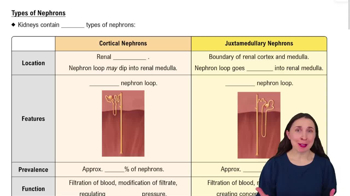
Nephron Tubular System

After filtration, creatinine travels through the nephron's tubular system, including the proximal convoluted tubule, loop of Henle, distal convoluted tubule, and collecting duct. These microscopic structures modify the filtrate by reabsorbing water and solutes, but creatinine remains largely unchanged, moving toward the renal pelvis.
Recommended video:
2:30
Types of Nephrons

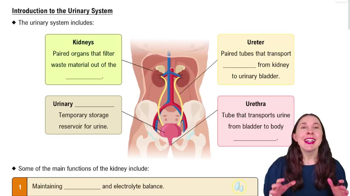
Urinary Tract Structures from Kidney to Urethra

From the collecting ducts, creatinine-containing urine flows into the renal calyces, then the renal pelvis, and down the ureters to the bladder. Finally, urine passes through the urethra during excretion. These gross anatomical structures transport urine out of the body.
Recommended video:
2:57
The Urinary System