
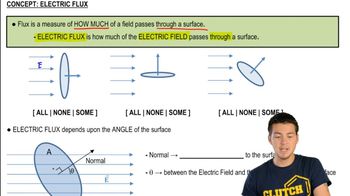
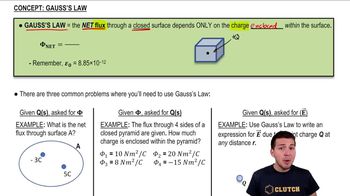
The nuclei of large atoms, such as uranium, with protons, can be modeled as spherically symmetric spheres of charge. The radius of the uranium nucleus is approximately m. The electrons can be modeled as forming a uniform shell of negative charge. What net electric field do they produce at the location of the nucleus?
Some planetary scientists have suggested that the planet Mars has an electric field somewhat similar to that of the earth, producing a net electric flux of Nm2/C at the planet's surface. Calculate the total electric charge on the planet.
Verified step by step guidance
Verified video answer for a similar problem:
Key Concepts
Electric Flux
Gauss's Law
Permittivity of Free Space
The nuclei of large atoms, such as uranium, with protons, can be modeled as spherically symmetric spheres of charge. The radius of the uranium nucleus is approximately m. What is the electric field this nucleus produces just outside its surface?
Some planetary scientists have suggested that the planet Mars has an electric field somewhat similar to that of the earth, producing a net electric flux of Nm2/C at the planet's surface. Calculate the electric field at the planet's surface (refer to the astronomical data inside the back cover).
A very long uniform line of charge has charge per unit length C/m and lies along the -axis. A second long uniform line of charge has charge per unit length C/m and is parallel to the -axis at m. What is the net electric field (magnitude and direction) at the following points on the -axis: (a) m and (b) m?
Some planetary scientists have suggested that the planet Mars has an electric field somewhat similar to that of the earth, producing a net electric flux of Nm2/C at the planet's surface. Calculate the charge density on Mars, assuming all the charge is uniformly distributed over the planet's surface.
A charged paint is spread in a very thin uniform layer over the surface of a plastic sphere of diameter cm, giving it a charge of C. Find the electric field just outside the paint layer;
