
Ch 31: Alternating Current
Young & Freedman Calc - University Physics 14th Edition
Young & Freedman Calc14th EditionUniversity PhysicsISBN: 9780321973610Not the one you use?Change textbook
Chapter 31, Problem 35a

A Step-Down Transformer. A transformer connected to a 120 V (rms) ac line is to supply 12.0 V (rms) to a portable electronic device. The load resistance in the secondary is 5.00 Ω. What should the ratio of primary to secondary turns of the transformer be?

Verified step by step guidance
1
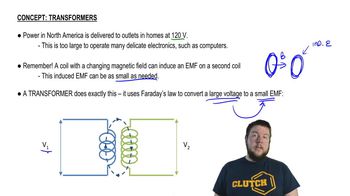
Understand the basic principle of a transformer: A transformer is a device that transfers electrical energy between two or more circuits through electromagnetic induction. It consists of primary and secondary coils. The voltage across these coils is related by the turns ratio.
Identify the given values: The primary voltage \( V_p \) is 120 V (rms), and the secondary voltage \( V_s \) is 12.0 V (rms). The load resistance \( R_s \) in the secondary is 5.00 \( \Omega \).
Use the formula for the turns ratio of a transformer: The turns ratio \( \frac{N_p}{N_s} \) is given by \( \frac{V_p}{V_s} \). This formula relates the primary and secondary voltages to the number of turns in the primary \( N_p \) and secondary \( N_s \) coils.
Substitute the given values into the formula: \( \frac{N_p}{N_s} = \frac{120}{12} \). This will give you the ratio of the number of turns in the primary coil to the number of turns in the secondary coil.
Interpret the result: The calculated turns ratio will tell you how many times more turns the primary coil should have compared to the secondary coil to achieve the desired voltage transformation.

Verified video answer for a similar problem:

This video solution was recommended by our tutors as helpful for the problem above.
Video duration:
2m
Was this helpful?

Key Concepts

Here are the essential concepts you must grasp in order to answer the question correctly.

Transformer Basics

A transformer is an electrical device that transfers electrical energy between two or more circuits through electromagnetic induction. It consists of primary and secondary coils, and it can either step up or step down voltage levels. The voltage change is determined by the ratio of the number of turns in the primary coil to the number of turns in the secondary coil.
Recommended video:

Turn Ratio

The turn ratio of a transformer is the ratio of the number of turns in the primary coil to the number of turns in the secondary coil. This ratio determines how the input voltage is transformed into the output voltage. For a step-down transformer, the primary coil has more turns than the secondary coil, resulting in a lower output voltage compared to the input voltage.
Recommended video:
Guided course
05:32
Ratio of energies of cylinder on surface

RMS Voltage

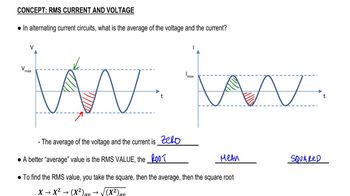
RMS (Root Mean Square) voltage is a measure of the effective value of an alternating current (AC) voltage. It represents the equivalent DC voltage that would deliver the same power to a load. In the context of transformers, RMS values are used to describe both the input and output voltages, ensuring that the power calculations are accurate and consistent.
Recommended video:
Guided course
07:14
RMS Current and Voltage