Ch 07: Potential Energy & Conservation
Young & Freedman Calc - University Physics 14th Edition
Young & Freedman Calc14th EditionUniversity PhysicsISBN: 9780321973610Not the one you use?Change textbook
Chapter 7, Problem 2

The maximum height a typical human can jump from a crouched start is about 6060 cm. By how much does the gravitational potential energy increase for a 7272-kg person in such a jump? Where does this energy come from?

Verified step by step guidance
1
Step 1: Understand the problem. The gravitational potential energy (GPE) is given by the formula: U=mgh, where m is the mass of the person (72 kg), g is the acceleration due to gravity (9.8 m/s²), and h is the height (0.60 m). The goal is to calculate the increase in GPE during the jump.
Step 2: Substitute the known values into the formula for GPE. Replace m with 72 kg, g with 9.8 m/s², and h with 0.60 m. The equation becomes: U=72×9.8×0.60.
Step 3: Recognize that the energy for this increase in gravitational potential energy comes from the chemical energy stored in the person's muscles. This energy is converted into kinetic energy during the jump, which is then transformed into gravitational potential energy at the peak of the jump.
Step 4: Perform the multiplication to calculate the increase in gravitational potential energy. Multiply the mass, gravitational acceleration, and height together: 72×9.8×0.60. This will give the result in joules (J), the unit of energy.
Step 5: Conclude by interpreting the result. The calculated value represents the increase in gravitational potential energy due to the jump. This energy originates from the chemical energy in the person's body, which is converted into mechanical energy during the jump.

Verified video answer for a similar problem:

This video solution was recommended by our tutors as helpful for the problem above.
Video duration:
4m
Was this helpful?

Key Concepts

Here are the essential concepts you must grasp in order to answer the question correctly.

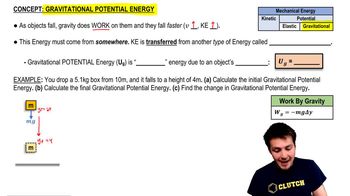
Gravitational Potential Energy

Gravitational potential energy (GPE) is the energy an object possesses due to its position in a gravitational field. It is calculated using the formula GPE = mgh, where m is mass, g is the acceleration due to gravity (approximately 9.81 m/s² on Earth), and h is the height above a reference point. In the context of the jump, the increase in GPE corresponds to the height the person reaches during the jump.
Recommended video:
Guided course
06:35
Gravitational Potential Energy

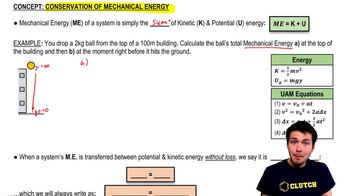
Energy Conservation

The principle of energy conservation states that energy cannot be created or destroyed, only transformed from one form to another. In the case of a jump, the kinetic energy generated during the crouched start is converted into gravitational potential energy as the person ascends. This transformation is crucial for understanding how the energy used in the jump is accounted for.
Recommended video:
Guided course
06:24
Conservation Of Mechanical Energy

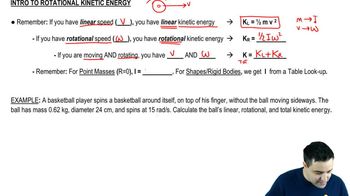
Kinetic Energy

Kinetic energy is the energy of an object in motion, defined by the formula KE = 0.5mv², where m is mass and v is velocity. When a person crouches and then jumps, they convert muscular energy into kinetic energy as they push off the ground. This kinetic energy is what propels them upward, ultimately converting into gravitational potential energy at the peak of the jump.
Recommended video:
Guided course
06:07
Intro to Rotational Kinetic Energy