The maximum height a typical human can jump from a crouched start is about cm. By how much does the gravitational potential energy increase for a -kg person in such a jump? Where does this energy come from?
Ch 07: Potential Energy & Conservation
Young & Freedman Calc14th EditionUniversity PhysicsISBN: 9780321973610Not the one you use?Change textbook
Chapter 7, Problem 1a
In one day, a -kg mountain climber ascends from the -m level on a vertical cliff to the top at m. The next day, she descends from the top to the base of the cliff, which is at an elevation of m. What is her change in gravitational potential energy on the first day?
Verified step by step guidance1
Step 1: Recall the formula for gravitational potential energy, which is given by: , where is the gravitational potential energy, is the mass of the object, is the acceleration due to gravity (approximately 9.8 m/s²), and is the height above a reference point.
Step 2: Calculate the change in gravitational potential energy for the first day. The change in gravitational potential energy is given by: , where is the final height and is the initial height.
Step 3: Substitute the given values into the formula. The mass of the climber is kg, the acceleration due to gravity is m/s², the initial height is m, and the final height is m.
Step 4: Perform the subtraction for the height difference: m. This gives the height difference.
Step 5: Multiply the mass, acceleration due to gravity, and the height difference to find the change in gravitational potential energy: . This will give the change in gravitational potential energy for the first day.

Verified video answer for a similar problem:
This video solution was recommended by our tutors as helpful for the problem above.
Video duration:
3mWas this helpful?
Key Concepts
Here are the essential concepts you must grasp in order to answer the question correctly.
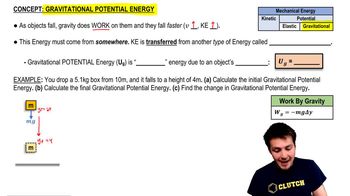
Gravitational Potential Energy
Gravitational potential energy (GPE) is the energy an object possesses due to its position in a gravitational field. It is calculated using the formula GPE = mgh, where m is mass, g is the acceleration due to gravity (approximately 9.81 m/s² on Earth), and h is the height above a reference point. In this scenario, the climber's change in height directly affects her GPE.
Recommended video:
Guided course
Gravitational Potential Energy
Change in Height
The change in height is a critical factor in determining the change in gravitational potential energy. It is calculated by subtracting the initial height from the final height. In the given problem, the climber ascends from 1500 m to 2400 m, resulting in a height change of 900 m, which is essential for calculating the GPE change.
Recommended video:
Guided course
Specific Heat & Temperature Changes
Mass and Weight
Mass is a measure of the amount of matter in an object, typically measured in kilograms. Weight, on the other hand, is the force exerted by gravity on that mass, calculated as weight = mass × gravity. In this problem, the climber's mass of 75 kg is used to determine the gravitational potential energy change as she ascends the cliff.
Recommended video:
Guided course
Torque Due to Weight
Related Practice
Textbook Question
2790
views
Textbook Question
Tarzan, in one tree, sights Jane in another tree. He grabs the end of a vine with length m that makes an angle of with the vertical, steps off his tree limb, and swings down and then up to Jane's open arms. When he arrives, his vine makes an angle of with the vertical. Determine whether he gives her a tender embrace or knocks her off her limb by calculating Tarzan's speed just before he reaches Jane. Ignore air resistance and the mass of the vine.
1928
views
3
rank
Textbook Question
A slingshot will shoot a -g pebble m straight up. How much potential energy is stored in the slingshot's rubber band?
1442
views