
Ch 21: Heat Engines and Refrigerators
Knight Calc - Physics for Scientists and Engineers 5th Edition
Knight Calc5th EditionPhysics for Scientists and EngineersISBN: 9780137344796Not the one you use?Change textbook
Chapter 21, Problem 55a

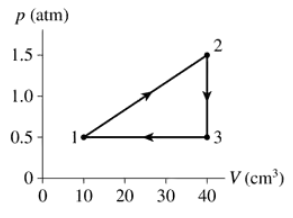
A heat engine using a diatomic gas follows the cycle shown in FIGURE P21.55. Its temperature at point 1 is 20℃. Determine Ws, Q, and ∆Eth for each of the three processes in this cycle. Display your results in a table.

Verified step by step guidance
1
Step 1: Understand the problem and identify the cycle. The problem involves a heat engine using a diatomic gas undergoing a thermodynamic cycle. The cycle consists of three processes, and we need to calculate the work done (Wₛ), heat transfer (Q), and change in internal energy (∆Eₜₕ) for each process. Recall that for a diatomic gas, the degrees of freedom affect the specific heat capacities.
Step 2: Apply the first law of thermodynamics for each process. The first law states that ΔEₜₕ = Q - Wₛ, where ΔEₜₕ is the change in internal energy, Q is the heat added to the system, and Wₛ is the work done by the system. This relationship will be used to calculate the required quantities for each process.
Step 3: Analyze each process in the cycle. For example: (a) If the process is isothermal, the temperature remains constant, and the change in internal energy (ΔEₜₕ) is zero. Use the formula for work done during isothermal expansion or compression: Wₛ = nRT ln(V₂/V₁). (b) If the process is adiabatic, Q = 0, and the work done can be calculated using the adiabatic relation. (c) If the process is isochoric, the volume remains constant, and Wₛ = 0. Use Q = nCᵥΔT to calculate the heat transfer.
Step 4: Use the specific heat capacities for a diatomic gas. For a diatomic gas, the molar specific heat at constant volume (Cᵥ) is (5/2)R, and the molar specific heat at constant pressure (Cₚ) is (7/2)R. These values will be used to calculate Q and ΔEₜₕ for the processes where temperature changes.
Step 5: Organize the results in a table. After calculating Wₛ, Q, and ΔEₜₕ for each process, display the results in a table format with rows corresponding to the processes and columns for Wₛ, Q, and ΔEₜₕ. Ensure all calculations are consistent with the thermodynamic principles and the given initial conditions (e.g., temperature at point 1 is 20℃).

Verified video answer for a similar problem:

This video solution was recommended by our tutors as helpful for the problem above.
Was this helpful?

Key Concepts

Here are the essential concepts you must grasp in order to answer the question correctly.

Heat Engine

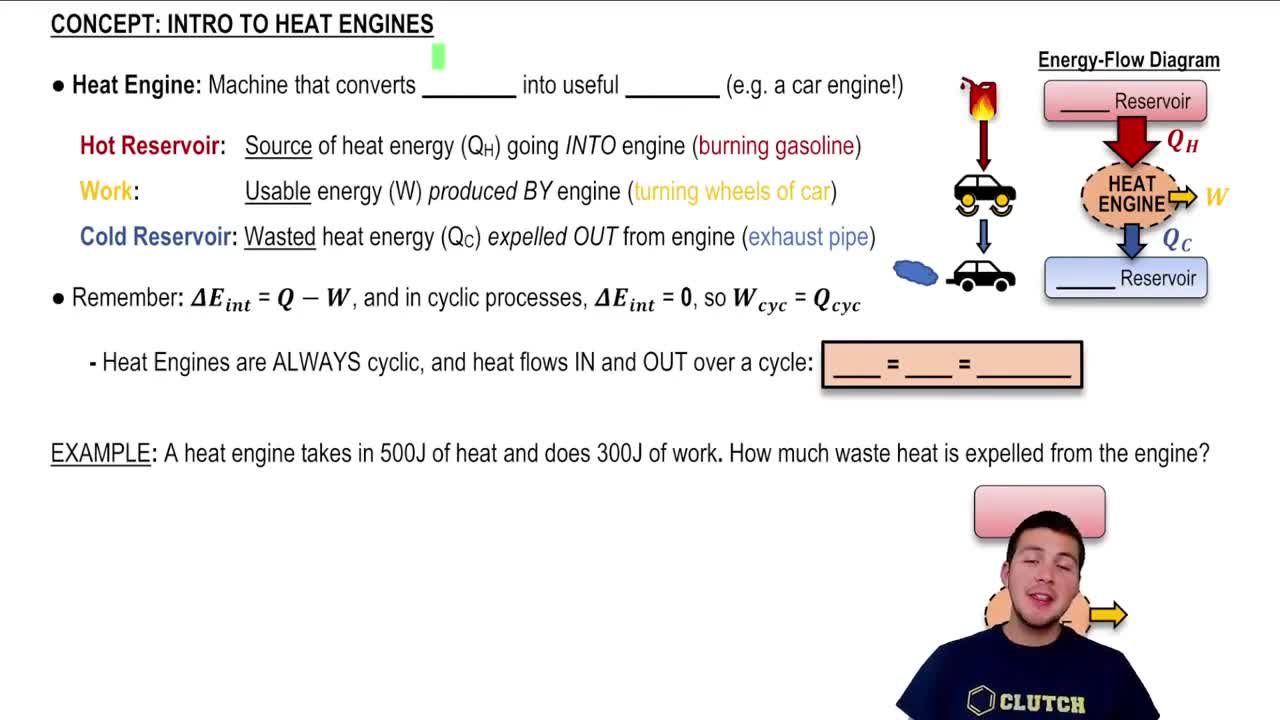
A heat engine is a device that converts thermal energy into mechanical work by exploiting the temperature difference between a hot reservoir and a cold reservoir. It operates in a cyclic process, absorbing heat from the hot reservoir, performing work, and releasing some heat to the cold reservoir. The efficiency of a heat engine is determined by the ratio of work output to heat input.
Recommended video:
Guided course
07:35
Introduction to Heat Engines

First Law of Thermodynamics

The First Law of Thermodynamics states that energy cannot be created or destroyed, only transformed from one form to another. In the context of a heat engine, this law can be expressed as ΔU = Q - W, where ΔU is the change in internal energy, Q is the heat added to the system, and W is the work done by the system. This principle is essential for analyzing energy transfers in thermodynamic processes.
Recommended video:
Guided course
08:04
The First Law of Thermodynamics

Diatomic Gas Properties

Diatomic gases, such as nitrogen or oxygen, have unique thermodynamic properties due to their molecular structure, which allows for rotational and vibrational modes of energy storage. This affects their specific heat capacities, which are crucial for calculating heat transfer and work done during processes. Understanding these properties is vital for accurately determining the thermodynamic quantities in the heat engine cycle.
Recommended video:
Guided course
08:45
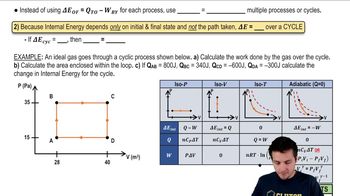
Properties of Cyclic Thermodynamic Processes
Related Practice
Textbook Question

A car's internal combustion engine can be modeled as a heat engine operating between a combustion temperature of 1500℃ and an air temperature of 20℃ with 30% of the Carnot efficiency. The heat of combustion of gasoline is 47 kJ/g. What mass of gasoline is burned to accelerate a 1500 kg car from rest to a speed of 30 m/s?

2095
views
Textbook Question

A heat engine uses a diatomic gas that follows the pV cycle in FIGURE P21.59. Determine the pressure, volume, and temperature at point 2.

260
views
Textbook Question

A typical coal-fired power plant burns 300 metric tons of coal every hour to generate 750 MW of electricity. 1 metric ton = 1000 kg. The density of coal is 1500 kg/m³ and its heat of combustion is 28 MJ/kg. Assume that all heat is transferred from the fuel to the boiler and that all the work done in spinning the turbine is transformed into electric energy. Suppose the coal is piled up in a 10 m ✕ 10 m room. How tall must the pile be to operate the plant for one day?

1904
views
Textbook Question

A nuclear power plant generates 3000 MW of heat energy from nuclear reactions in the reactor's core. This energy is used to boil water and produce high-pressure steam at 300℃. The steam spins a turbine, which produces 1000 MW of electric power, then the steam is condensed and the water is cooled to 25℃ before starting the cycle again. What is the plant's actual efficiency?

1758
views
Textbook Question

FIGURE P21.57 shows the cycle for a heat engine that uses a gas having γ = 1.25. The initial temperature is T1 = 300 K, and this engine operates at 20 cycles per second. What is the power output of the engine?

1574
views
Textbook Question

The heat engine shown in FIGURE P21.62 uses 2.0 mol of a monatomic gas as the working substance. Determine T1, T2 and T3.

284
views