
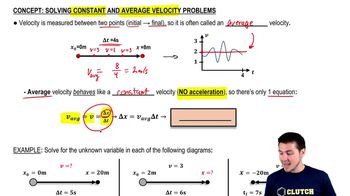
Starting from the front door of a ranch house, you walk m due east to a windmill, turn around, and then slowly walk m west to a bench, where you sit and watch the sunrise. It takes you s to walk from the house to the windmill and then s to walk from the windmill to the bench. For the entire trip from the front door to the bench, what are your (a) average velocity? (b) average speed?
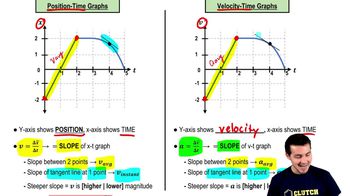
A ball moves in a straight line (the -axis). The graph in Fig. E shows this ball's velocity as a function of time. What are the ball's average speed and average velocity during the first s?

Verified step by step guidance
Verified video answer for a similar problem:
Key Concepts
Average Speed
Average Velocity
Velocity-Time Graph
A physics professor leaves her house and walks along the sidewalk toward campus. After min, it starts to rain, and she returns home. Her distance from her house as a function of time is shown in Fig. E. At which of the labeled points is her velocity constant and positive?
A physics professor leaves her house and walks along the sidewalk toward campus. After min, it starts to rain, and she returns home. Her distance from her house as a function of time is shown in Fig. E. At which of the labeled points is her velocity zero?
A physics professor leaves her house and walks along the sidewalk toward campus. After min, it starts to rain, and she returns home. Her distance from her house as a function of time is shown in Fig. E. At which of the labeled points is her velocity constant and negative?
A car is stopped at a traffic light. It then travels along a straight road such that its distance from the light is given by , where m/s2 and m/s3. Calculate the instantaneous velocity of the car at , s, and s.
A car is stopped at a traffic light. It then travels along a straight road such that its distance from the light is given by , where m/s2 and m/s3. Calculate the average velocity of the car for the time interval to s.
