Ch 01: Units, Physical Quantities & Vectors
Young & Freedman Calc - University Physics 14th Edition
Young & Freedman Calc14th EditionUniversity PhysicsISBN: 9780321973610Not the one you use?Change textbook
Chapter 1, Problem 24a

For the vectors A and B in Fig. E1.24, use a scale drawing to find the magnitude and direction of the vector sum A + B
Vector diagram showing vectors A and B with magnitudes and angles for adding vectors graphically.

Verified step by step guidance
1
Identify the components of vector A and vector B. Vector A is 8.0 m along the negative y-axis, and vector B is 15.0 m at an angle of 30 degrees from the positive y-axis.
Break down vector B into its x and y components using trigonometry. The x-component of B is Bx = B * sin(30°) and the y-component of B is By = B * cos(30°).
Since vector A is along the negative y-axis, its components are Ax = 0 and Ay = -8.0 m.
Add the components of vectors A and B to find the components of the resultant vector R = A + B. Rx = Ax + Bx and Ry = Ay + By.
Calculate the magnitude of the resultant vector R using the Pythagorean theorem: |R| = sqrt(Rx^2 + Ry^2). Determine the direction of R by finding the angle θ with respect to the x-axis using θ = arctan(Ry/Rx).

Verified video answer for a similar problem:

This video solution was recommended by our tutors as helpful for the problem above.
Video duration:
1m
Was this helpful?

Key Concepts

Here are the essential concepts you must grasp in order to answer the question correctly.

Vector Addition

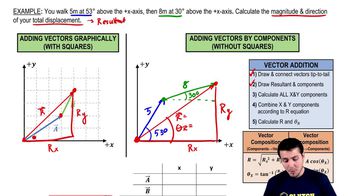
Vector addition involves combining two or more vectors to determine a resultant vector. This can be done graphically using the head-to-tail method, where the tail of one vector is placed at the head of another. The resultant vector is drawn from the tail of the first vector to the head of the last vector, representing both magnitude and direction.
Recommended video:
Guided course
07:30
Vector Addition By Components

Magnitude and Direction

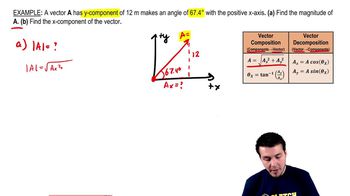
The magnitude of a vector is a measure of its length, representing the quantity it describes, such as distance or force. The direction indicates the orientation of the vector in space, often expressed in degrees relative to a reference axis. Understanding both magnitude and direction is crucial for accurately representing and calculating vector quantities.
Recommended video:
Guided course
03:59
Calculating Magnitude & Components of a Vector

Scale Drawing

A scale drawing is a representation of an object or scenario where the dimensions are proportionally reduced or enlarged to fit a specific scale. In vector addition, scale drawings allow for visualizing the vectors and their resultant by using a consistent scale to measure lengths and angles, making it easier to determine the resultant vector's magnitude and direction.
Recommended video:
Guided course
04:54
Introduction To Temperature Scales