A useful and easy-to-remember approximate value for the number of seconds in a year is π × 107. Determine the percent error in this approximate value. (There are 365.24 days in one year.)
Ch 01: Units, Physical Quantities & Vectors
Young & Freedman Calc14th EditionUniversity PhysicsISBN: 9780321973610Not the one you use?Change textbook
All textbooks
Young & Freedman Calc 14th Edition
Ch 01: Units, Physical Quantities & Vectors
Problem 20a
Young & Freedman Calc 14th Edition
Ch 01: Units, Physical Quantities & Vectors
Problem 20aChapter 1, Problem 20a
Four astronauts are in a spherical space station. If, as is typical, each of them breathes about 500 cm3 of air with each breath, approximately what volume of air (in cubic meters) do these astronauts breathe in a year?
Verified step by step guidance1
First, determine the volume of air each astronaut breathes per breath. This is given as 500 cm³. Convert this volume to cubic meters using the conversion factor: 1 cm³ = 1 × 10⁻⁶ m³.
Calculate the total volume of air each astronaut breathes in one day. Assume an average breathing rate of 12 breaths per minute. Multiply the number of breaths per minute by the number of minutes in a day (60 minutes/hour × 24 hours/day) to find the total number of breaths per day.
Multiply the total number of breaths per day by the volume of air per breath (in cubic meters) to find the daily volume of air each astronaut breathes.
To find the annual volume of air each astronaut breathes, multiply the daily volume by the number of days in a year (365 days).
Finally, calculate the total volume of air breathed by all four astronauts in a year by multiplying the annual volume for one astronaut by four.

Verified video answer for a similar problem:
This video solution was recommended by our tutors as helpful for the problem above.
Video duration:
4mWas this helpful?
Key Concepts
Here are the essential concepts you must grasp in order to answer the question correctly.
Volume Conversion
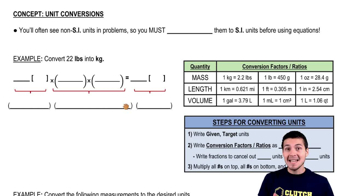
Understanding volume conversion is crucial for this problem, as it involves converting the volume of air from cubic centimeters to cubic meters. Since 1 cubic meter equals 1,000,000 cubic centimeters, you need to divide the total volume in cubic centimeters by 1,000,000 to convert it to cubic meters.
Recommended video:
Guided course
Unit Conversions
Breathing Rate Calculation
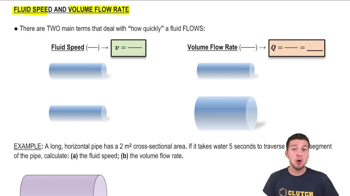
To determine the total volume of air breathed in a year, you must calculate the number of breaths taken annually. This involves multiplying the number of breaths per minute by the number of minutes in an hour, hours in a day, and days in a year. This calculation provides the total number of breaths taken by an astronaut in a year.
Recommended video:
Guided course
Fluid Speed & Volume Flow Rate
Multiplication of Volumes
Once you have the number of breaths per year, multiply this by the volume of air per breath to find the total volume of air breathed by one astronaut. Since there are four astronauts, multiply the result by four to get the total volume of air breathed by all astronauts in a year.
Recommended video:
Guided course
Volume Thermal Expansion
Related Practice
Textbook Question
1368
views
Textbook Question
How many gallons of gasoline are used in the United States in one day? Assume that there are two cars for every three people, that each car is driven an average of 10,000 miles per year, and that the average car gets 20 miles per gallon.
1481
views
Textbook Question
How many times does a typical person blink her eyes in a lifetime?
703
views
Textbook Question
How many times does a human heart beat during a person's lifetime? How many gallons of blood does it pump?
801
views
Textbook Question
You are using water to dilute small amounts of chemicals in the laboratory, drop by drop. How many drops of water are in a 1.0-L bottle?
649
views
Textbook Question
For the vectors A and B in Fig. E1.24, use a scale drawing to find the magnitude and direction of the vector sum A + B
4968
views