Ch 11: Impulse and Momentum
Knight Calc - Physics for Scientists and Engineers 5th Edition
Knight Calc5th EditionPhysics for Scientists and EngineersISBN: 9780137344796Not the one you use?Change textbook
Chapter 11, Problem 3

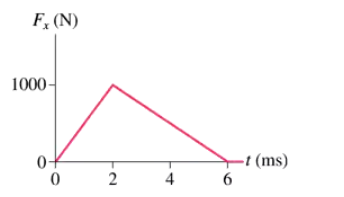
What impulse does the force shown in FIGURE EX11.3 exert on a 250 g particle?

Verified step by step guidance
1
Step 1: Recall the formula for impulse, which is the integral of force over time: \( J = \int F_x \, dt \). Impulse can also be calculated as the area under the force-time graph.
Step 2: Analyze the graph provided. The force \( F_x \) increases linearly from 0 N to 15 N over a time interval of 12 ms. The graph forms a triangle with a base of 12 ms and a height of 15 N.
Step 3: Calculate the area of the triangle to determine the impulse. The area of a triangle is given by \( \text{Area} = \frac{1}{2} \times \text{base} \times \text{height} \). Here, the base is 12 ms (convert to seconds: \( 12 \times 10^{-3} \) s), and the height is 15 N.
Step 4: Substitute the values into the area formula: \( \text{Area} = \frac{1}{2} \times (12 \times 10^{-3}) \times 15 \). This area represents the impulse exerted on the particle.
Step 5: The impulse calculated from the area is in units of \( \text{N} \cdot \text{s} \). This impulse is the total change in momentum of the 250 g particle due to the force applied.

Verified video answer for a similar problem:

This video solution was recommended by our tutors as helpful for the problem above.
Video duration:
4m
Was this helpful?

Key Concepts

Here are the essential concepts you must grasp in order to answer the question correctly.

Impulse

Impulse is defined as the change in momentum of an object when a force is applied over a period of time. It is mathematically represented as the product of the average force and the time duration during which the force acts. In the context of the given question, the impulse can be calculated by finding the area under the force vs. time graph.
Recommended video:
Guided course
06:00
Impulse & Impulse-Momentum Theorem

Force vs. Time Graph

A force vs. time graph visually represents how force changes over time. The area under the curve of this graph corresponds to the impulse experienced by an object. In the provided graph, the shape consists of a triangle and a rectangle, which can be used to calculate the total impulse exerted on the 250 g particle.
Recommended video:
Guided course
05:59
Velocity-Time Graphs & Acceleration

Mass and Weight

Mass is a measure of the amount of matter in an object, typically measured in kilograms (kg), while weight is the force exerted by gravity on that mass. In this question, the mass of the particle is given as 250 g, which is equivalent to 0.25 kg. Understanding the relationship between mass, weight, and impulse is crucial for analyzing the motion of the particle after the force is applied.
Recommended video:
Guided course
10:19
Torque Due to Weight