Ch 02: Motion Along a Straight Line
Young & Freedman Calc - University Physics 14th Edition
Young & Freedman Calc14th EditionUniversity PhysicsISBN: 9780321973610Not the one you use?Change textbook
Chapter 2, Problem 48b

A large boulder is ejected vertically upward from a volcano with an initial speed of 40.040.0 m/s. Ignore air resistance. At what time is it moving at 20.020.0 m/s downward?

Verified step by step guidance
1
Identify the initial conditions: The boulder is ejected with an initial speed of 40.0 m/s upward. We need to find the time when its speed is 20.0 m/s downward.
Understand the motion: The boulder is subject to gravitational acceleration, which is approximately 9.8 m/s² downward. This will slow it down as it moves upward, stop it momentarily, and then accelerate it downward.
Use the kinematic equation for velocity: The velocity of an object under constant acceleration can be described by the equation: v=vi-gt, where v is the final velocity, vi is the initial velocity, g is the acceleration due to gravity, and t is the time.
Set up the equation: Substitute the known values into the equation. The final velocity v is -20.0 m/s (downward), vi is 40.0 m/s, and g is 9.8 m/s². The equation becomes: -20.0=40.0-9.8t.
Solve for time t: Rearrange the equation to solve for t. This involves isolating t on one side of the equation: t=(40.0--20.0)9.8. Calculate the value of t.

Verified video answer for a similar problem:

This video solution was recommended by our tutors as helpful for the problem above.
Video duration:
2m
Was this helpful?

Key Concepts

Here are the essential concepts you must grasp in order to answer the question correctly.

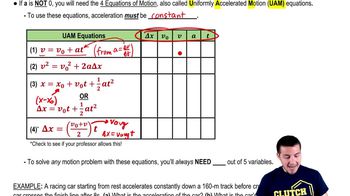
Kinematics Equations

Kinematics equations describe the motion of objects under constant acceleration. They are essential for calculating the position, velocity, and time of an object in motion. In this problem, the equations help determine the time at which the boulder reaches a specific velocity while moving downward.
Recommended video:
Guided course
08:25
Kinematics Equations

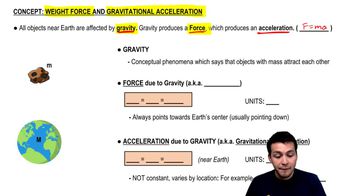
Gravitational Acceleration

Gravitational acceleration is the constant acceleration experienced by objects due to Earth's gravity, approximately 9.81 m/s² downward. This concept is crucial for understanding the motion of the boulder as it moves upward and then downward, affecting its velocity and time of travel.
Recommended video:
Guided course
07:32
Weight Force & Gravitational Acceleration

Velocity Direction

Velocity direction indicates whether an object is moving upward or downward. In this problem, understanding that the boulder initially moves upward and then downward is key to determining when its velocity is 20.0 m/s downward, requiring consideration of both magnitude and direction.
Recommended video:
Guided course
7:27
Escape Velocity
Related Practice
Textbook Question

A large boulder is ejected vertically upward from a volcano with an initial speed of 40.040.0 m/s. Ignore air resistance. At what time after being ejected is the boulder moving at 20.020.0 m/s upward?

2187
views
Textbook Question

A large boulder is ejected vertically upward from a volcano with an initial speed of 40.040.0 m/s. Ignore air resistance. When is the velocity of the boulder zero?

1711
views
Textbook Question

A large boulder is ejected vertically upward from a volcano with an initial speed of 40.040.0 m/s. Ignore air resistance. What are the magnitude and direction of the acceleration while the boulder is (i) moving upward? (ii) Moving downward? (iii) At the highest point?

1538
views
Textbook Question

A large boulder is ejected vertically upward from a volcano with an initial speed of 40.040.0 m/s. Ignore air resistance. When is the displacement of the boulder from its initial position zero?

1897
views
Textbook Question

A 1515-kg rock is dropped from rest on the earth and reaches the ground in 1.751.75 s. When it is dropped from the same height on Saturn's satellite Enceladus, the rock reaches the ground in 18.618.6 s. What is the acceleration due to gravity on Enceladus?

2607
views
Textbook Question

An egg is thrown nearly vertically upward from a point near the cornice of a tall building. The egg just misses the cornice on the way down and passes a point 30.030.0 m below its starting point 5.005.00 s after it leaves the thrower's hand. Ignore air resistance. What are the magnitude and direction of its acceleration at the highest point?

1735
views