
Textbook Question
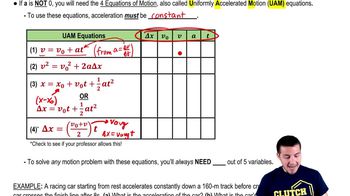
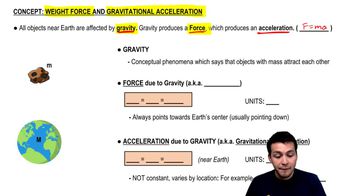
A large boulder is ejected vertically upward from a volcano with an initial speed of m/s. Ignore air resistance. At what time after being ejected is the boulder moving at m/s upward?
2187
views

 Verified step by step guidance
 08:25
08:25
 07:32
07:32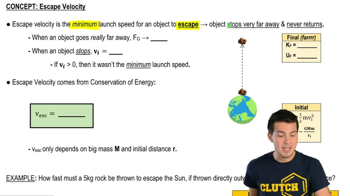 7:27
7:27A large boulder is ejected vertically upward from a volcano with an initial speed of m/s. Ignore air resistance. At what time after being ejected is the boulder moving at m/s upward?
A large boulder is ejected vertically upward from a volcano with an initial speed of m/s. Ignore air resistance. When is the velocity of the boulder zero?
A large boulder is ejected vertically upward from a volcano with an initial speed of m/s. Ignore air resistance. What are the magnitude and direction of the acceleration while the boulder is (i) moving upward? (ii) Moving downward? (iii) At the highest point?
A large boulder is ejected vertically upward from a volcano with an initial speed of m/s. Ignore air resistance. When is the displacement of the boulder from its initial position zero?
A -kg rock is dropped from rest on the earth and reaches the ground in s. When it is dropped from the same height on Saturn's satellite Enceladus, the rock reaches the ground in s. What is the acceleration due to gravity on Enceladus?
An egg is thrown nearly vertically upward from a point near the cornice of a tall building. The egg just misses the cornice on the way down and passes a point m below its starting point s after it leaves the thrower's hand. Ignore air resistance. What are the magnitude and direction of its acceleration at the highest point?