
Ch 21: Heat Engines and Refrigerators
Knight Calc - Physics for Scientists and Engineers 5th Edition
Knight Calc5th EditionPhysics for Scientists and EngineersISBN: 9780137344796Not the one you use?Change textbook
Chapter 21, Problem 38

The engine that powers a crane burns fuel at a flame temperature of 2000℃. It is cooled by 20℃ air. The crane lifts a 2000 kg steel girder 30 m upward. How much heat energy is transferred to the engine by burning fuel if the engine is 40% as efficient as a Carnot engine?

Verified step by step guidance
1
Convert the given temperatures from Celsius to Kelvin using the formula: \( T(K) = T(℃) + 273.15 \). For the flame temperature, \( T_{hot} = 2000 + 273.15 \), and for the cooling air, \( T_{cold} = 20 + 273.15 \).
Calculate the efficiency of a Carnot engine using the formula: \( \eta_{Carnot} = 1 - \frac{T_{cold}}{T_{hot}} \). Substitute the values of \( T_{cold} \) and \( T_{hot} \) in Kelvin to find \( \eta_{Carnot} \).
Determine the actual efficiency of the engine, which is 40% of the Carnot efficiency. Use the formula: \( \eta_{actual} = 0.4 \times \eta_{Carnot} \).
Calculate the work done by the crane to lift the girder using the formula: \( W = m \cdot g \cdot h \), where \( m = 2000 \ \mathrm{kg} \), \( g = 9.8 \ \mathrm{m/s^2} \), and \( h = 30 \ \mathrm{m} \).
Relate the work done to the heat energy transferred to the engine using the efficiency formula: \( \eta_{actual} = \frac{W}{Q_{in}} \). Rearrange to solve for \( Q_{in} \): \( Q_{in} = \frac{W}{\eta_{actual}} \). Substitute the values of \( W \) and \( \eta_{actual} \) to find the heat energy transferred.

Verified video answer for a similar problem:

This video solution was recommended by our tutors as helpful for the problem above.
Video duration:
7m
Was this helpful?

Key Concepts

Here are the essential concepts you must grasp in order to answer the question correctly.

Carnot Efficiency

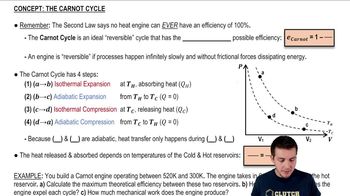
Carnot efficiency is the maximum possible efficiency of a heat engine operating between two temperature reservoirs. It is defined by the formula η = 1 - (T_c / T_h), where T_c is the absolute temperature of the cold reservoir and T_h is the absolute temperature of the hot reservoir. This concept sets an ideal benchmark for real engines, indicating that no engine can be more efficient than a Carnot engine operating between the same temperatures.
Recommended video:
Guided course
06:28
The Carnot Cycle and Maximum Theoretical Efficiency

Heat Transfer

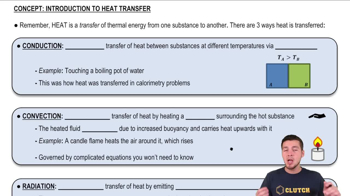
Heat transfer refers to the movement of thermal energy from one object or system to another due to a temperature difference. In the context of engines, heat is transferred from the combustion of fuel to the working fluid, which then performs work, such as lifting a load. Understanding how heat is transferred and utilized is crucial for calculating the energy output and efficiency of the engine.
Recommended video:
Guided course
05:14
Overview of Heat Transfer

Work Done by the Engine

The work done by an engine is the energy transferred to lift an object against gravity, calculated using the formula W = mgh, where m is the mass, g is the acceleration due to gravity, and h is the height lifted. In this scenario, the crane lifts a 2000 kg girder 30 m, and calculating this work is essential for determining the total energy input required from the fuel burned, factoring in the engine's efficiency.
Recommended video:
Guided course
05:58
Work Done By Springs
Related Practice
Textbook Question

A freezer with a coefficient of performance 30% that of a Carnot refrigerator keeps the inside temperature at -22℃ in a 25℃ room. 3.0 L of water at 20℃ are placed in the freezer. How long does it take for the water to freeze if the freezer's compressor does work at the rate of 200 W while the water is freezing?

1826
views
Textbook Question

An ideal refrigerator utilizes a Carnot cycle operating between 0℃ and 25℃. To turn 10 kg of liquid water at 0℃ into 10 kg of ice at 0℃, (a) how much heat is exhausted into the room and (b) how much energy must be supplied to the refrigerator?

1548
views
Textbook Question

Which, if any, of the heat engines in FIGURE EX21.22 violate (a) the first law of thermodynamics or (b) the second law of thermodynamics? Explain.

1606
views
Textbook Question

A Carnot refrigerator operates between energy reservoirs at 0℃ and 250℃. A 2.4-cm-diameter, 50-cm-long copper bar connects the two energy reservoirs. At what rate, in W, must work be done on the refrigerator to remove heat from the cold reservoir at the same rate that it arrives through the copper bar?

1715
views
Textbook Question

At what cold-reservoir temperature (in ℃) would a Carnot engine with a hot-reservoir temperature of 427℃ have an efficiency of 60%?

2140
views
Textbook Question

A Carnot engine whose hot-reservoir temperature is 400℃ has a thermal efficiency of 40%. By how many degrees should the temperature of the cold reservoir be decreased to raise the engine's efficiency to 60%?

1727
views