

Ch 15: Oscillations
Knight Calc - Physics for Scientists and Engineers 5th Edition
Knight Calc5th EditionPhysics for Scientists and EngineersISBN: 9780137344796Not the one you use?Change textbook
Chapter 15, Problem 36

A 350 g mass on a 45-cm-long string is released at an angle of 4.5° from vertical. It has a damping constant of 0.010 kg/s. After 25 s, (a) how many oscillations has it completed and (b) what fraction of the initial energy has been lost?

Verified step by step guidance
1
Step 1: Convert the given values into SI units. The mass is 350 g, which is equivalent to 0.35 kg. The string length is 45 cm, which is equivalent to 0.45 m. The damping constant is already in SI units (0.010 kg/s).
Step 2: Calculate the angular frequency of the undamped pendulum using the formula ω₀ = √(g / L), where g is the acceleration due to gravity (9.8 m/s²) and L is the length of the string. Substitute the values to find ω₀.
Step 3: Determine the damped angular frequency using the formula ω = √(ω₀² - (b / (2m))²), where b is the damping constant and m is the mass of the pendulum. Substitute the values to find ω.
Step 4: Calculate the number of oscillations completed in 25 seconds using the formula N = (ω / (2π)) × t, where t is the time in seconds. Substitute the values to find N.
Step 5: Determine the fraction of the initial energy lost using the formula E/E₀ = e^(-bt/m), where b is the damping constant, t is the time, and m is the mass. Substitute the values to find the fraction of energy remaining, and subtract this from 1 to find the fraction lost.

Verified video answer for a similar problem:

This video solution was recommended by our tutors as helpful for the problem above.
Video duration:
14m
Was this helpful?

Key Concepts

Here are the essential concepts you must grasp in order to answer the question correctly.

Simple Harmonic Motion (SHM)

Simple Harmonic Motion refers to the oscillatory motion of an object where the restoring force is directly proportional to the displacement from its equilibrium position. In the case of a pendulum, this motion occurs when the angle of displacement is small, allowing the motion to be approximated as sinusoidal. The period of oscillation depends on the length of the string and the acceleration due to gravity.
Recommended video:
Guided course
07:52
Simple Harmonic Motion of Pendulums

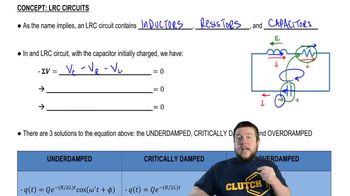
Damping

Damping is the effect that reduces the amplitude of oscillations in a system over time, often due to friction or resistance. In this scenario, the damping constant quantifies how quickly the energy of the oscillating mass decreases. The presence of damping leads to a gradual loss of energy, affecting both the number of oscillations completed and the fraction of initial energy lost.
Recommended video:

Energy Conservation in Oscillations

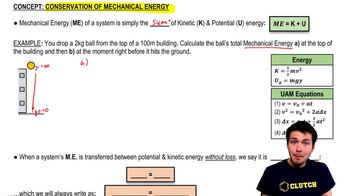
In oscillatory systems, energy is exchanged between kinetic and potential forms. Initially, the mass has maximum potential energy at its highest point, which converts to kinetic energy as it swings down. However, due to damping, some energy is lost as heat or sound, which can be calculated to determine how much of the initial energy remains after a certain number of oscillations.
Recommended video:
Guided course
06:24
Conservation Of Mechanical Energy
Related Practice
Textbook Question

Vision is blurred if the head is vibrated at 29 Hz because the vibrations are resonant with the natural frequency of the eyeball in its socket. If the mass of the eyeball is 7.5 g, a typical value, what is the effective spring constant of the musculature that holds the eyeball in the socket?

1919
views
Textbook Question

A 100 g block attached to a spring with spring constant 2.5 N/m oscillates horizontally on a frictionless table. Its velocity is 20 c/m when 𝓍 = -5.0 cm What is the block's position when the acceleration is maximum?

1341
views
Textbook Question

Two 500 g air-track gliders are each connected by identical springs with spring constant 25 N/m to the ends of the air track. The gliders are connected to each other by a spring with spring constant 2.0 N/m. One glider is pulled 8.0 cm to the side and released while the other is at rest at its equilibrium position. How long will it take until the glider that was initially at rest has all the motion while the first glider is at rest?

1860
views
Textbook Question

When the displacement of a mass on a spring is (½)A, what fraction of the energy is kinetic energy and what fraction is potential energy?

2301
views
Textbook Question

In a science museum, a 110 kg brass pendulum bob swings at the end of a 15.0-m-long wire. The pendulum is started at exactly 8:00 a.m. every morning by pulling it 1.5 m to the side and releasing it. Because of its compact shape and smooth surface, the pendulum's damping constant is only 0.010 kg/s. At exactly 12:00 noon, how many oscillations will the pendulum have completed and what is its amplitude?

1450
views
Textbook Question

The amplitude of an oscillator decreases to 36.8% of its initial value in 10.0 s. What is the value of the time constant?

1718
views