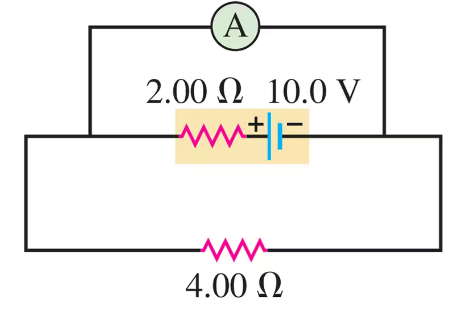
The circuit shown in Fig. E contains two batteries, each with an emf and an internal resistance, and two resistors. Find the current in the circuit (magnitude and direction).
Ch 25: Current, Resistance, and EMF
Young & Freedman Calc14th EditionUniversity PhysicsISBN: 9780321973610Not the one you use?Change textbook
Chapter 25, Problem 28c
An idealized ammeter is connected to a battery as shown in Fig. E. Find the terminal voltage of the battery.

Verified step by step guidance1
Identify the components in the circuit: a battery with an emf of 12.0 V, a resistor of 8.0 Ω, and another resistor of 6.0 Ω.
Understand that the terminal voltage of the battery is the voltage across the battery when the circuit is closed, which is the emf minus the voltage drop due to the internal resistance.
Calculate the total resistance in the circuit. Since the resistors are in series, the total resistance R_total is the sum of the resistances: R_total = 8.0 Ω + 6.0 Ω.
Use Ohm's Law to find the current I in the circuit. Ohm's Law states that I = V / R, where V is the emf of the battery and R is the total resistance.
Calculate the terminal voltage V_terminal using the formula V_terminal = emf - I * r, where r is the internal resistance of the battery. If the internal resistance is not given, assume it is negligible for an ideal battery.

Verified video answer for a similar problem:
This video solution was recommended by our tutors as helpful for the problem above.
Video duration:
3mWas this helpful?
Key Concepts
Here are the essential concepts you must grasp in order to answer the question correctly.
Ohm's Law
Ohm's Law states that the current through a conductor between two points is directly proportional to the voltage across the two points and inversely proportional to the resistance. It is expressed as V = IR, where V is voltage, I is current, and R is resistance. This law is fundamental for analyzing electrical circuits and calculating the current flowing through components.
Recommended video:
Guided course
Resistance and Ohm's Law
Series Circuit
In a series circuit, components are connected end-to-end, forming a single path for current flow. The total resistance in a series circuit is the sum of individual resistances, and the same current flows through each component. Understanding series circuits is crucial for calculating the total resistance and voltage drops across each component, which affects the terminal voltage of the battery.
Recommended video:
Guided course
LRC Circuits in Series
Terminal Voltage
Terminal voltage is the voltage output of a battery when it is connected in a circuit, accounting for any internal resistance. It is calculated by subtracting the voltage drop across the internal resistance from the electromotive force (EMF) of the battery. In practical terms, terminal voltage is the actual voltage available to the external circuit, which can be less than the battery's EMF due to internal resistance.
Recommended video:
Guided course
RMS Current and Voltage
Related Practice
Textbook Question
1590
views
Textbook Question
A copper transmission cable km long and cm in diameter carries a current of A. How much electrical energy is dissipated as thermal energy every hour?
2090
views
Textbook Question
The circuit shown in Fig. E contains two batteries, each with an emf and an internal resistance, and two resistors. Find the terminal voltage of the -V battery.
1810
views
Textbook Question
An idealized ammeter is connected to a battery as shown in Fig. E. Find the reading of the ammeter.
2581
views
Textbook Question
The circuit shown in Fig. E contains two batteries, each with an emf and an internal resistance, and two resistors. Find the potential difference of point with respect to point .
1974
views
Textbook Question
An idealized ammeter is connected to a battery as shown in Fig. E. Find the current through the - resistor.
2106
views