
Ch 13: Gravitation
Young & Freedman Calc - University Physics 14th Edition
Young & Freedman Calc14th EditionUniversity PhysicsISBN: 9780321973610Not the one you use?Change textbook
Chapter 13, Problem 4

Two uniform spheres, each with mass M and radius R, touch each other. What is the magnitude of their gravitational force of attraction?

Verified step by step guidance
1
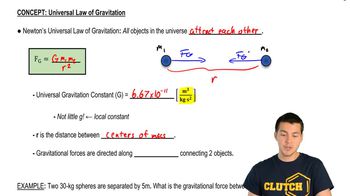
Identify the formula for the gravitational force between two masses: \( F = \frac{G \cdot m_1 \cdot m_2}{r^2} \), where \( G \) is the gravitational constant, \( m_1 \) and \( m_2 \) are the masses of the two objects, and \( r \) is the distance between the centers of the two masses.
Since the spheres are touching each other, the distance \( r \) between their centers is equal to the sum of their radii, which is \( 2R \).
Substitute the given values into the formula: \( F = \frac{G \cdot M \cdot M}{(2R)^2} \).
Simplify the expression: \( F = \frac{G \cdot M^2}{4R^2} \).
This expression gives the magnitude of the gravitational force of attraction between the two spheres.

Verified video answer for a similar problem:

This video solution was recommended by our tutors as helpful for the problem above.
Video duration:
2m
Was this helpful?

Key Concepts

Here are the essential concepts you must grasp in order to answer the question correctly.

Newton's Law of Universal Gravitation

Newton's Law of Universal Gravitation states that every point mass attracts every other point mass in the universe with a force that is directly proportional to the product of their masses and inversely proportional to the square of the distance between their centers. The formula is F = G * (m1 * m2) / r^2, where G is the gravitational constant.
Recommended video:
Guided course
04:05
Universal Law of Gravitation

Center of Mass

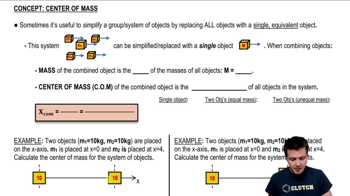
The center of mass of an object is the point at which the mass of the object is considered to be concentrated for the purpose of analyzing translational motion. For uniform spheres, the center of mass is at the geometric center. When calculating gravitational force between two spheres, the distance between their centers of mass is used.
Recommended video:
Guided course
06:30
Intro to Center of Mass

Gravitational Constant (G)

The gravitational constant, denoted as G, is a fundamental constant in physics that quantifies the strength of the gravitational force between two masses. Its value is approximately 6.674 × 10^-11 N(m/kg)^2. It is crucial for calculating gravitational forces in Newton's Law of Universal Gravitation.
Recommended video:
Guided course
08:59
Phase Constant of a Wave Function