
Ch 22: Gauss' Law
Young & Freedman Calc - University Physics 14th Edition
Young & Freedman Calc14th EditionUniversity PhysicsISBN: 9780321973610Not the one you use?Change textbook
Chapter 22, Problem 26b

A very large, horizontal, nonconducting sheet of charge has uniform charge per unit area σ=5.00×10⁶\(\sigma\)=5.00\(\times\)10^{-6} C/m2. A small sphere of mass m=8.00×10⁶m=8.00\(\times\)10^{-6} kg and charge qq is placed 3.00 3.00 cm above the sheet of charge and then released from rest. What is qq if the sphere is released 1.501.50 cm above the sheet?

Verified step by step guidance
1
Step 1: Understand the problem setup. We have a large sheet with a uniform charge density \( \sigma = 5.00 \times 10^{-6} \text{ C/m}^2 \). A small sphere with mass \( m = 8.00 \times 10^{-6} \text{ kg} \) and charge \( q \) is placed above the sheet. We need to find the charge \( q \) when the sphere is released from different heights above the sheet.
Step 2: Use Gauss's Law to find the electric field \( E \) due to the sheet. For an infinite sheet of charge, the electric field is given by \( E = \frac{\sigma}{2\varepsilon_0} \), where \( \varepsilon_0 \) is the permittivity of free space \( \varepsilon_0 = 8.85 \times 10^{-12} \text{ C}^2/\text{N} \cdot \text{m}^2 \).
Step 3: Calculate the force \( F \) acting on the sphere due to the electric field. The force is given by \( F = qE \). Since the sphere is released from rest, this force will cause it to accelerate towards the sheet.
Step 4: Apply Newton's second law to relate the force to the acceleration \( a \) of the sphere. According to Newton's second law, \( F = ma \), where \( m \) is the mass of the sphere. Therefore, \( qE = ma \).
Step 5: Solve for the charge \( q \). Rearrange the equation \( qE = ma \) to find \( q = \frac{ma}{E} \). Substitute the values for \( m \), \( a \), and \( E \) to find \( q \). Note that the acceleration \( a \) can be determined from the change in height and the initial conditions of the sphere's motion.

Verified video answer for a similar problem:

This video solution was recommended by our tutors as helpful for the problem above.
Video duration:
4m
Was this helpful?

Key Concepts

Here are the essential concepts you must grasp in order to answer the question correctly.

Electric Field due to a Charged Sheet

The electric field generated by an infinite sheet of charge is uniform and perpendicular to the surface. It is given by E = σ / (2ε₀), where σ is the charge density and ε₀ is the permittivity of free space. This field does not depend on the distance from the sheet, making it crucial for understanding the forces acting on nearby charged objects.
Recommended video:
Guided course
06:28
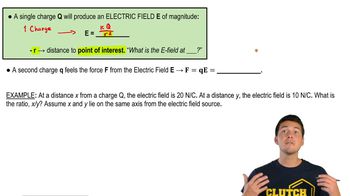
Electric Field due to a Point Charge

Force on a Charged Particle in an Electric Field

A charged particle in an electric field experiences a force given by F = qE, where q is the charge of the particle and E is the electric field strength. This force influences the motion of the particle, and understanding it is essential for predicting how the sphere will move when released above the charged sheet.
Recommended video:
Guided course
06:28
Electric Field due to a Point Charge

Gravitational Force

The gravitational force acting on an object is given by F = mg, where m is the mass of the object and g is the acceleration due to gravity. In this scenario, the gravitational force opposes the electric force, and analyzing the balance between these forces is key to determining the charge q required for equilibrium or specific motion.
Recommended video:
Guided course
05:41
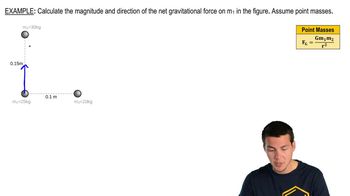
Gravitational Forces in 2D
Related Practice
Textbook Question

A very large, horizontal, nonconducting sheet of charge has uniform charge per unit area σ=5.00×10⁶\(\sigma\)=5.00\(\times\)10^{-6} C/m2. A small sphere of mass m=8.00×10⁶m=8.00\(\times\)10^{-6} kg and charge qq is placed 3.00 3.00 cm above the sheet of charge and then released from rest. If the sphere is to remain motionless when it is released, what must be the value of qq?

2571
views
Textbook Question

A conductor with an inner cavity, like that shown in Fig. 22.2322.23c, carries a total charge of +5.00+5.00 nC. The charge within the cavity, insulated from the conductor, is 6.00−6.00 nC. How much charge is on (a) the inner surface of the conductor and (b) the outer surface of the conductor?

3054
views
Textbook Question

An infinitely long cylindrical conductor has radius r r and uniform surface charge density σσ. In terms of σσ, what is the magnitude of the electric field produced by the charged cylinder at a distance r>Rr > R from its axis? Then, express the result in terms of λλ and show that the electric field outside the cylinder is the same as if all the charge were on the axis.

4487
views
1
rank
Textbook Question

Charge qq is distributed uniformly throughout the volume of an insulating sphere of radius R=4.00R = 4.00 cm. At a distance of r=8.00r = 8.00 cm from the center of the sphere, the electric field due to the charge distribution has magnitude E=940E = 940 N/C. What is the electric field at a distance of 2.002.00 cm from the sphere's center?

2034
views
Textbook Question

An infinitely long cylindrical conductor has radius r r and uniform surface charge density σσ. In terms of σσ and RR, what is the charge per unit length λλ for the cylinder?

2450
views
1
rank
Textbook Question

A very long conducting tube (hollow cylinder) has inner radius AA and outer radius bb. It carries charge per unit length +α, where αα is a positive constant with units of C/m. A line of charge lies along the axis of the tube. The line of charge has charge per unit length. Calculate the electric field in terms of αα and the distance rr from the axis of the tube for (i) r<ar < a; (ii) a<r<ba < r < b; (iii) r>br > b. Show your results in a graph of EE as a function of RR.

2382
views
1
rank