
Two 65 kg astronauts leave earth in a spacecraft, sitting 1.0 m apart. How far are they from the center of the earth when the gravitational force between them is as strong as the gravitational force of the earth on one of the astronauts?
Ch 13: Newton's Theory of Gravity
Knight Calc5th EditionPhysics for Scientists and EngineersISBN: 9780137344796Not the one you use?Change textbook
Chapter 13, Problem 11
A recently discovered extrasolar planet appears to be rockier and denser than earth. It is 16 times as massive as earth, but its diameter is only twice that of earth. What is the free-fall acceleration on the surface of this planet?
Verified step by step guidance1
Step 1: Recall the formula for gravitational acceleration on the surface of a planet: , where is the gravitational constant, is the mass of the planet, and is the radius of the planet.
Step 2: Compare the mass and diameter of the extrasolar planet to Earth. The mass of the planet is 16 times Earth's mass (), and its diameter is twice Earth's diameter. Since the radius is half the diameter, the radius of the planet is .
Step 3: Substitute the values for mass and radius into the formula for gravitational acceleration. Replace with and with : .
Step 4: Simplify the expression. The denominator becomes . The formula now becomes: .
Step 5: Further simplify the fraction. Divide the numerator and denominator by 4: . Recognize that this is 4 times Earth's gravitational acceleration, . Therefore, the free-fall acceleration on the surface of the planet is 4 times Earth's gravity.

Verified video answer for a similar problem:
This video solution was recommended by our tutors as helpful for the problem above.
Video duration:
2mWas this helpful?
Key Concepts
Here are the essential concepts you must grasp in order to answer the question correctly.
Gravitational Acceleration
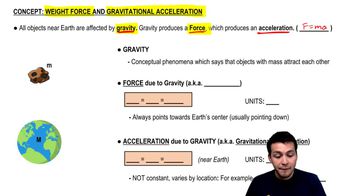
Gravitational acceleration is the acceleration experienced by an object due to the gravitational force exerted by a massive body, such as a planet. It is commonly denoted by 'g' and varies depending on the mass of the planet and the distance from its center. The formula to calculate gravitational acceleration at the surface of a planet is g = G * M / R², where G is the gravitational constant, M is the mass of the planet, and R is its radius.
Recommended video:
Guided course
Weight Force & Gravitational Acceleration
Mass and Density Relationship
The mass of an object is a measure of the amount of matter it contains, while density is defined as mass per unit volume. For a planet, if its mass increases while its volume does not increase proportionally, its density will also increase. In this case, the planet's mass is 16 times that of Earth, and its diameter is only twice that of Earth, indicating a higher density than Earth.
Recommended video:
Guided course
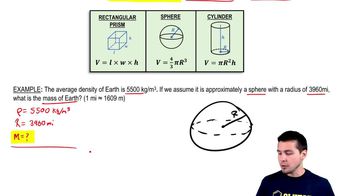
Problems with Mass, Volume, & Density
Volume and Radius of a Sphere
The volume of a sphere is calculated using the formula V = (4/3)πR³, where R is the radius. Since the diameter is twice that of Earth, the radius of the new planet is also twice that of Earth. This relationship is crucial for determining the volume and subsequently the density of the planet, which affects the calculation of gravitational acceleration.
Recommended video:
Guided course
Volume Thermal Expansion
Related Practice
Textbook Question
1352
views
Textbook Question
Suppose we could shrink the earth without changing its mass. At what fraction of its current radius would the free-fall acceleration at the surface be three times its present value?
1551
views
Textbook Question
Asteroid 253 Mathilde is one of several that have been visited by space probes. This asteroid is roughly spherical with a diameter of 53 km. The free-fall acceleration at the surface is 9.9 ✕ 10-3 m/s2. What is the asteroid's mass?
1423
views
Textbook Question
What is the free-fall acceleration at the surface of (a) the moon and (b) Jupiter?
1869
views
1
rank
Textbook Question
What is the escape speed from Jupiter?
2404
views
Textbook Question
What is the force of attraction between a 50 kg woman and a 70 kg man sitting 1.0 m apart?
1510
views
