Ch 01: Units, Physical Quantities & Vectors
Young & Freedman Calc - University Physics 14th Edition
Young & Freedman Calc14th EditionUniversity PhysicsISBN: 9780321973610Not the one you use?Change textbook
Chapter 1, Problem 44a

Find the vector product A x B (expressed in unit vectors) of the two vectors given in Exercise 1.38. What is the magnitude of the vector product? Given two vectors A = 4.00 i + 7.00j and B = 5.00 i − 2.00

Verified step by step guidance
1
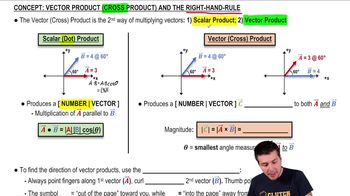
Understand the vector product (also known as the cross product) of two vectors A and B. The cross product is a vector that is perpendicular to both A and B and is given by the formula: A x B = (A_y * B_z - A_z * B_y) i + (A_z * B_x - A_x * B_z) j + (A_x * B_y - A_y * B_x) k.
Identify the components of vectors A and B. For vector A = 4.00 i + 7.00 j, the components are A_x = 4.00, A_y = 7.00, and A_z = 0 (since there is no k component). For vector B = 5.00 i - 2.00 j, the components are B_x = 5.00, B_y = -2.00, and B_z = 0.
Substitute the components of vectors A and B into the cross product formula. Since both vectors have no k component, the formula simplifies to: A x B = (7.00 * 0 - 0 * -2.00) i + (0 * 5.00 - 4.00 * 0) j + (4.00 * -2.00 - 7.00 * 5.00) k.
Calculate each component of the resulting vector from the cross product. The i and j components will be zero due to the absence of k components in A and B, and the k component will be calculated using the values: (4.00 * -2.00 - 7.00 * 5.00).
Determine the magnitude of the vector product. The magnitude of a vector V = V_x i + V_y j + V_z k is given by the formula: |V| = sqrt(V_x^2 + V_y^2 + V_z^2). Since the i and j components are zero, the magnitude will be |V| = sqrt((4.00 * -2.00 - 7.00 * 5.00)^2).

Verified video answer for a similar problem:

This video solution was recommended by our tutors as helpful for the problem above.
Video duration:
5m
Was this helpful?

Key Concepts

Here are the essential concepts you must grasp in order to answer the question correctly.

Vector Product (Cross Product)

The vector product, or cross product, of two vectors results in a third vector that is perpendicular to the plane containing the original vectors. It is calculated using the determinant of a matrix formed by unit vectors and the components of the given vectors. The direction follows the right-hand rule, and the magnitude is given by |A||B|sin(θ), where θ is the angle between A and B.
Recommended video:
Guided course
10:30
Vector (Cross) Product and the Right-Hand-Rule

Unit Vectors

Unit vectors are vectors with a magnitude of one, used to indicate direction in space. In Cartesian coordinates, the standard unit vectors are i, j, and k, representing the x, y, and z axes, respectively. They are essential in expressing vectors in component form, allowing for operations like addition, subtraction, and cross product to be performed algebraically.
Recommended video:

Magnitude of a Vector

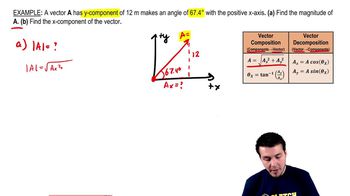
The magnitude of a vector is a measure of its length or size, calculated using the square root of the sum of the squares of its components. For a vector resulting from a cross product, the magnitude can be found using the formula |A x B| = |A||B|sin(θ), which represents the area of the parallelogram formed by the original vectors. This is crucial for understanding the scale of the resulting vector.
Recommended video:
Guided course
03:59
Calculating Magnitude & Components of a Vector