Ch 09: Work and Kinetic Energy
Knight Calc - Physics for Scientists and Engineers 5th Edition
Knight Calc5th EditionPhysics for Scientists and EngineersISBN: 9780137344796Not the one you use?Change textbook
Chapter 9, Problem 65

Astronomers using a 2.0-m-diameter telescope observe a distant supernova - an exploding star. The telescope's detector records 9.1 x 10⁻¹¹ J of light energy during the first 10 s. It's known that this type of supernova has a visible-light power output of 5.0 x 1037 W for the first 10 s of the explosion. How distant is the supernova? Give your answer in light years, where one light year is the distance light travels in one year. The speed of light is 3.0 x 10⁸ m/s.

Verified step by step guidance
1
Step 1: Understand the problem. The telescope collects a certain amount of light energy from the supernova over 10 seconds. The supernova's total power output is given, and we need to calculate the distance to the supernova. The relationship between power, energy, and distance will be key here.
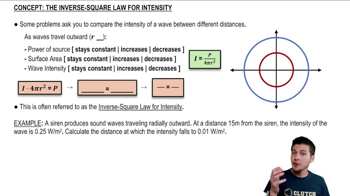
Step 2: Use the inverse square law for light intensity. The energy collected by the telescope is proportional to the power output of the supernova divided by the square of the distance. The formula is: \( I = \frac{P}{4 \pi d^2} \), where \( I \) is the intensity (energy per unit area), \( P \) is the power output, and \( d \) is the distance.
Step 3: Calculate the intensity of light received by the telescope. The telescope collects \( 9.1 \times 10^{-11} \ \text{J} \) over 10 seconds, so the intensity is \( I = \frac{E}{A \cdot t} \), where \( E \) is the energy collected, \( A \) is the area of the telescope's aperture, and \( t \) is the time. The area of the telescope's aperture is \( A = \pi r^2 \), where \( r \) is the radius of the telescope (half the diameter).
Step 4: Rearrange the inverse square law to solve for the distance \( d \). Substitute the calculated intensity \( I \) and the given power \( P \) into the formula \( d = \sqrt{\frac{P}{4 \pi I}} \). This will give the distance in meters.
Step 5: Convert the distance from meters to light years. Use the fact that one light year is the distance light travels in one year, which is \( c \cdot T \), where \( c = 3.0 \times 10^8 \ \text{m/s} \) is the speed of light and \( T = 365.25 \cdot 24 \cdot 60 \cdot 60 \ \text{s} \) is the number of seconds in a year. Divide the distance in meters by the distance of one light year to get the final answer in light years.

Verified video answer for a similar problem:

This video solution was recommended by our tutors as helpful for the problem above.
Video duration:
8m
Was this helpful?

Key Concepts

Here are the essential concepts you must grasp in order to answer the question correctly.

Power and Energy

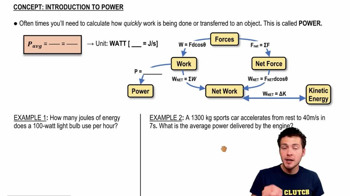
Power is the rate at which energy is transferred or converted, measured in watts (W), where 1 W equals 1 joule per second. In this context, the supernova emits a constant power output of 5.0 x 10³⁷ W, meaning it releases 5.0 x 10³⁷ joules of energy every second. Understanding the relationship between power and energy is crucial for calculating the total energy emitted over a specific time period.
Recommended video:

Distance and Light Travel Time

The distance light travels in one year is defined as one light year, approximately 9.46 x 10¹² kilometers. To find the distance to the supernova, we can use the energy recorded by the telescope and the known power output of the supernova to determine how long the light took to reach the telescope. This involves calculating the total energy emitted and relating it to the distance using the speed of light.
Recommended video:
10:30
Ray Nature of Light

Inverse Square Law

The inverse square law states that the intensity of light or other forms of radiation from a point source decreases with the square of the distance from the source. This principle is essential in astronomy, as it helps determine how the observed energy from the supernova relates to its actual power output and distance. By applying this law, we can calculate how far the light traveled to reach the telescope based on the energy detected.
Recommended video:
Guided course
05:26
The Inverse-Square Law for Intensity
Related Practice
Textbook Question

Write a realistic problem for which this is the correct equation(s).

T(1500kg)(9.8m/s2)=(1500kg)(1.0m/s2)T-(1500\,\(\text{kg}\))(9.8\,\(\text{m/s}\)^2)=(1500\,\(\text{kg}\))\(\left\)(1.0\,\(\text{m/s}\)^2\(\right\))

P=T(2.0m/s)P=T(2.0\,\(\text{m/s}\))

1907
views
Textbook Question

A Porsche 944 Turbo has a rated engine power of 217 hp. 30% of the power is lost in the engine and the drive train, and 70% reaches the wheels. The total mass of the car and driver is 1480 kg, and two-thirds of the weight is over the drive wheels. How long does it take the Porsche to reach the maximum power output?

1908
views
Textbook Question

A Porsche 944 Turbo has a rated engine power of 217 hp. 30% of the power is lost in the engine and the drive train, and 70% reaches the wheels. The total mass of the car and driver is 1480 kg, and two-thirds of the weight is over the drive wheels. If the Porsche accelerates at amax, what is its speed when it reaches maximum power output?

2035
views
Textbook Question

Draw a pictorial representation.

T(1500kg)(9.8m/s2)=(1500kg)(1.0m/s2)T-(1500\,\(\text{kg}\))(9.8\,\(\text{m/s}\)^2)=(1500\,\(\text{kg}\))\(\left\)(1.0\,\(\text{m/s}\)^2\(\right\))

P=T(2.0m/s)P=T(2.0\,\(\text{m/s}\))

815
views
Textbook Question

Finish the solution of the problem.

T(1500kg)(9.8m/s2)=(1500kg)(1.0m/s2)T-(1500\,\(\text{kg}\))(9.8\,\(\text{m/s}\)^2)=(1500\,\(\text{kg}\))\(\left\)(1.0\,\(\text{m/s}\)^2\(\right\))

P=T(2.0m/s)P=T(2.0\,\(\text{m/s}\))

1973
views
Textbook Question

A farmer uses a tractor to pull a 150 kg bale of hay up a 15° incline to the barn at a steady 5.0 km/h. The coefficient of kinetic friction between the bale and the ramp is 0.45. What is the tractor's power output?

2173
views