
A pickup truck is carrying a toolbox, but the rear gate of the truck is missing. The toolbox will slide out if it is set moving. The coefficients of kinetic friction and static friction between the box and the level bed of the truck are and , respectively. Starting from rest, what is the shortest time this truck could accelerate uniformly to m/s without causing the box to slide? Draw a free-body diagram of the toolbox.
Two crates connected by a rope lie on a horizontal surface (Fig. E). Crate A has mass , and crate B has mass . The coefficient of kinetic friction between each crate and the surface is . The crates are pulled to the right at constant velocity by a horizontal force . Draw one or more free-body diagrams to calculate the following in terms of , , and : the tension in the rope connecting the blocks.

Verified step by step guidance
Verified video answer for a similar problem:
Key Concepts
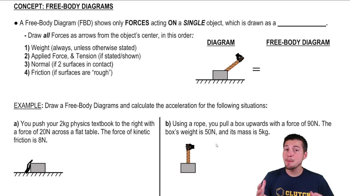
Free-Body Diagram
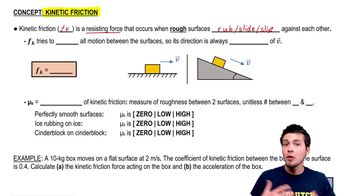
Kinetic Friction
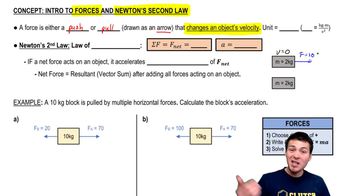
Newton's Second Law
Two crates connected by a rope lie on a horizontal surface (Fig. E). Crate A has mass , and crate B has mass . The coefficient of kinetic friction between each crate and the surface is . The crates are pulled to the right at constant velocity by a horizontal force . Draw one or more free-body diagrams to calculate the following in terms of , , and : the magnitude of .
You throw a baseball straight upward. The drag force is proportional to . In terms of , what is the -component of the ball's acceleration when the ball's speed is half its terminal speed and it is moving back down?
If the skydiver's daughter, whose mass is kg, is falling through the air and has the same ( kg/m) as her father, what is the daughter's terminal speed?
A -kg box of textbooks rests on a loading ramp that makes an angle with the horizontal. The coefficient of kinetic friction is , and the coefficient of static friction is . At this angle, find the acceleration once the box has begun to move.
You throw a baseball straight upward. The drag force is proportional to . In terms of , what is the -component of the ball's acceleration when the ball's speed is half its terminal speed and it is moving up?
