
A ductile metal wire has resistance . What will be the resistance of this wire in terms of if it is stretched to three times its original length, assuming that the density and resistivity of the material do not change when the wire is stretched? (Hint: The amount of metal does not change, so stretching out the wire will affect its cross-sectional area.)
Ch 25: Current, Resistance, and EMF
Young & Freedman Calc14th EditionUniversity PhysicsISBN: 9780321973610Not the one you use?Change textbook
Chapter 25, Problem 7b
The current in a wire varies with time according to the relationship . What constant current would transport the same charge in the same time interval?
Verified step by step guidance1
First, understand that the problem involves finding a constant current that transports the same charge as a time-varying current over a given time interval.
To find the total charge transported by the time-varying current, integrate the current function I(t) = 55 A - (0.65 A/s^2)t^2 with respect to time over the interval from t = 0 to t = T, where T is the time interval.
The integral of the current function I(t) with respect to time will give the total charge Q transported: Q = ∫(55 - 0.65t^2) dt from 0 to T.
Calculate the integral: Q = [55t - (0.65/3)t^3] evaluated from 0 to T. This will give you the expression for the total charge transported by the time-varying current.
To find the constant current I_c that transports the same charge Q in the same time interval T, use the relationship Q = I_c * T. Solve for I_c by rearranging the equation: I_c = Q / T.

Verified video answer for a similar problem:
This video solution was recommended by our tutors as helpful for the problem above.
Video duration:
5mWas this helpful?
Key Concepts
Here are the essential concepts you must grasp in order to answer the question correctly.
Current and Charge Relationship
Current (I) is the rate at which charge (Q) flows through a conductor. The relationship between current and charge is given by Q = ∫I dt, where the integral of current over time gives the total charge transported. Understanding this relationship is crucial for determining the equivalent constant current that transports the same charge over a given time interval.
Recommended video:
Guided course
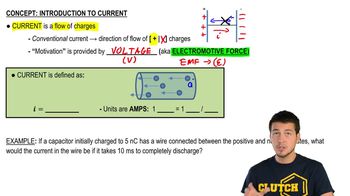
Intro to Current
Integration in Physics
Integration is a mathematical process used to find quantities like area under a curve, which in physics often represents accumulated quantities such as charge. In this context, integrating the current function I = 55 A - (0.65 A/s^2)t^2 over the specified time interval will yield the total charge transported, allowing comparison with a constant current scenario.
Recommended video:
Guided course
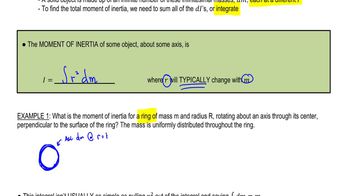
Finding Moment Of Inertia By Integrating
Constant Current
A constant current is one that does not change with time, unlike the given variable current. To find a constant current that transports the same charge, one must calculate the total charge transported by the variable current and then determine the constant current that would transport this charge over the same time interval, using the formula Q = I_constant × time.
Recommended video:
Guided course
Phase Constant of a Wave Function
Related Practice
Textbook Question
2322
views
Textbook Question
In household wiring, copper wire mm in diameter is often used. Find the resistance of a -m length of this wire.
1901
views
Textbook Question
A cylindrical tungsten filament cm long with a diameter of mm is to be used in a machine for which the temperature will range from room temperature (°C) up to °C. It will carry a current of A at all temperatures. What will be the maximum potential drop over the full length of the filament?
1816
views
Textbook Question
The current in a wire varies with time according to the relationship . How many coulombs of charge pass a cross section of the wire in the time interval between and ?
1881
views
1
rank
