Ch. 2 - The Chemistry of Microbiology
Bauman - Microbiology with Diseases by Taxonomy 6th Edition
Bauman6th EditionMicrobiology with Diseases by TaxonomyISBN: 9780134832302Not the one you use?Change textbook
Chapter 2, Problem 1

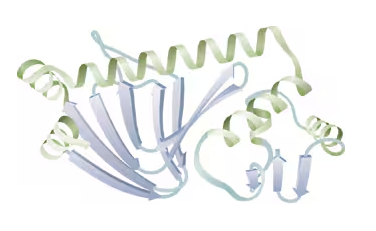
In the following molecule, label a portion that shows only primary structure; label two types of secondary structure; circle the tertiary structure.
3D protein structure showing labeled primary sequence, two secondary structures (alpha helix and beta sheet), and circled tertiary structure.

Verified step by step guidance
1
Identify the primary structure by locating the linear sequence of amino acids in the protein. This is the simplest level of protein structure and is represented by the continuous chain of amino acids without any folding or coiling.
Locate the two types of secondary structures: the alpha helix and the beta sheet. The alpha helix appears as a coiled or spiral region in the protein, while the beta sheet is represented by flat, arrow-like structures that are often arranged side-by-side.
Label the alpha helix by selecting the helical, spiral-shaped portion of the protein structure. This is typically shown as a twisted ribbon or cylinder.
Label the beta sheet by selecting the flat, arrow-shaped regions that run alongside each other, often depicted as broad arrows pointing in a specific direction.
Circle the tertiary structure by encompassing the entire three-dimensional folded shape of the protein, which includes the arrangement of alpha helices, beta sheets, and other loops and folds. This represents the overall spatial conformation of the protein.

Verified video answer for a similar problem:

This video solution was recommended by our tutors as helpful for the problem above.
Video duration:
2m
Was this helpful?

Key Concepts

Here are the essential concepts you must grasp in order to answer the question correctly.

Primary Structure of Proteins

The primary structure is the linear sequence of amino acids in a polypeptide chain, linked by peptide bonds. It determines the protein's unique characteristics and serves as the foundation for higher-level structures.
Recommended video:
Guided course
04:53
Protein Structure

Secondary Structure of Proteins

Secondary structure refers to local folding patterns within a polypeptide, mainly alpha helices and beta sheets, stabilized by hydrogen bonds. These structures contribute to the protein's overall shape and stability.
Recommended video:
Guided course
04:53
Protein Structure

Tertiary Structure of Proteins

The tertiary structure is the three-dimensional folding of a single polypeptide chain, formed by interactions among side chains, including hydrophobic interactions, hydrogen bonds, and disulfide bridges. It defines the protein's functional conformation.
Recommended video:
Guided course
04:53
Protein Structure