
Ch. 8 - Microbial Genetics
Tortora - Microbiology: An Introduction 14th Edition
Tortora14th EditionMicrobiology: An IntroductionISBN: 9780138200398Not the one you use?Change textbook
Chapter 8, Problem 7

Which sequence is the best target for damage by UV radiation: AGGCAA, CTTTGA, or GUAAAU? Why aren’t all bacteria killed when they are exposed to sunlight?

Verified step by step guidance
1
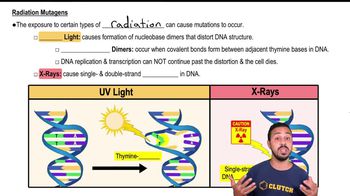
Step 1: Understand that UV radiation primarily causes damage by inducing the formation of thymine dimers in DNA, which are covalent linkages between adjacent thymine bases. This disrupts DNA replication and transcription.
Step 2: Analyze each sequence to identify which contains the most adjacent thymine (T) bases, as these are the primary targets for UV-induced damage. The sequences are: AGGCAA, CTTTGA, and GUAAAU (note that GUAAAU is RNA, not DNA).
Step 3: Recognize that the sequence CTTTGA contains three consecutive thymine bases (TTT), making it the most susceptible to UV damage due to the higher likelihood of thymine dimer formation.
Step 4: Understand that not all bacteria are killed by sunlight because many have DNA repair mechanisms, such as photoreactivation and nucleotide excision repair, which can reverse or remove UV-induced damage.
Step 5: Additionally, factors like bacterial pigmentation, biofilm formation, and the presence of protective enzymes can reduce UV damage, allowing some bacteria to survive sunlight exposure.

Verified video answer for a similar problem:

This video solution was recommended by our tutors as helpful for the problem above.
Video duration:
2m
Was this helpful?

Key Concepts

Here are the essential concepts you must grasp in order to answer the question correctly.

UV Radiation and DNA Damage

Ultraviolet (UV) radiation primarily damages DNA by causing the formation of thymine dimers, which are covalent bonds between adjacent thymine bases. Sequences rich in thymine or adjacent pyrimidines are more susceptible to UV-induced damage, disrupting DNA replication and transcription.
Recommended video:
Guided course
02:55
Radiation Mutagens

Nucleic Acid Composition and Susceptibility

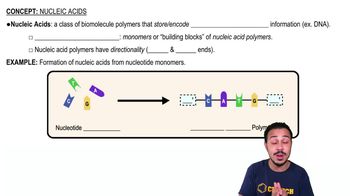
DNA sequences containing thymine (T) are more vulnerable to UV damage compared to RNA sequences or DNA sequences lacking thymine. For example, the sequence CTTTGA has multiple thymine bases, making it a better target for UV-induced thymine dimer formation than AGGCAA (which has fewer thymines) or GUAAAU (which is RNA and contains uracil instead).
Recommended video:
Guided course
03:22
Nucleic Acids

Bacterial DNA Repair Mechanisms and UV Resistance

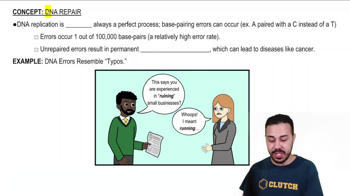
Not all bacteria are killed by sunlight because many possess DNA repair systems, such as photoreactivation and nucleotide excision repair, which can recognize and fix UV-induced DNA damage. These mechanisms allow bacteria to survive and recover from UV exposure, contributing to their resilience in sunlight.
Recommended video:
Related Practice
Textbook Question

Identify when (before transcription, after transcription but before translation, after translation) each of the following regulatory mechanisms functions.

a. ATP combines with an enzyme, altering its shape.

b. A short RNA is synthesized that is complementary to mRNA.

c. Methylation of DNA occurs.

d. An inducer combines with a repressor.

1290
views
Textbook Question

Use the following choices to answer the question:

a. Catabolite repression

b. DNA polymerase

c. Induction

d. Repression

e. Translation


Mechanism by which the presence of glucose inhibits the lac operon.

1199
views
Textbook Question

Use the following choices to answer the question:

a. Catabolite repression

b. DNA polymerase

c. Induction

d. Repression

e. Translation


The mechanism by which lactose controls the lac operon.

813
views
Textbook Question

Suppose you inoculate three flasks of minimal salts broth with E. coli. Flask A contains glucose. Flask B contains glucose and lactose. Flask C contains lactose. After a few hours of incubation, you test the flasks for the presence of ß-galactosidase. Which flask(s) do you predict will have this enzyme?

a. A

b. B

c. C

d. A and B

e. B and C

1524
views
Textbook Question

You are provided with cultures with the following characteristics:

Culture 1: F+, genotype A+B+C+

Culture 2: F ̄, genotype A ̄B ̄C ̄

a. Indicate the possible genotypes of a recombinant cell resulting from the conjugation of cultures 1 and 2.

b. Indicate the possible genotypes of a recombinant cell resulting from conjugation of the two cultures after the F+ has become an Hfr cell.

1425
views
Textbook Question

Plasmids differ from transposons in that plasmids

a. become inserted into chromosomes.

b. are self-replicated outside the chromosome.

c. move from chromosome to chromosome.

d. carry genes for antibiotic resistance.

e. none of the above

1457
views