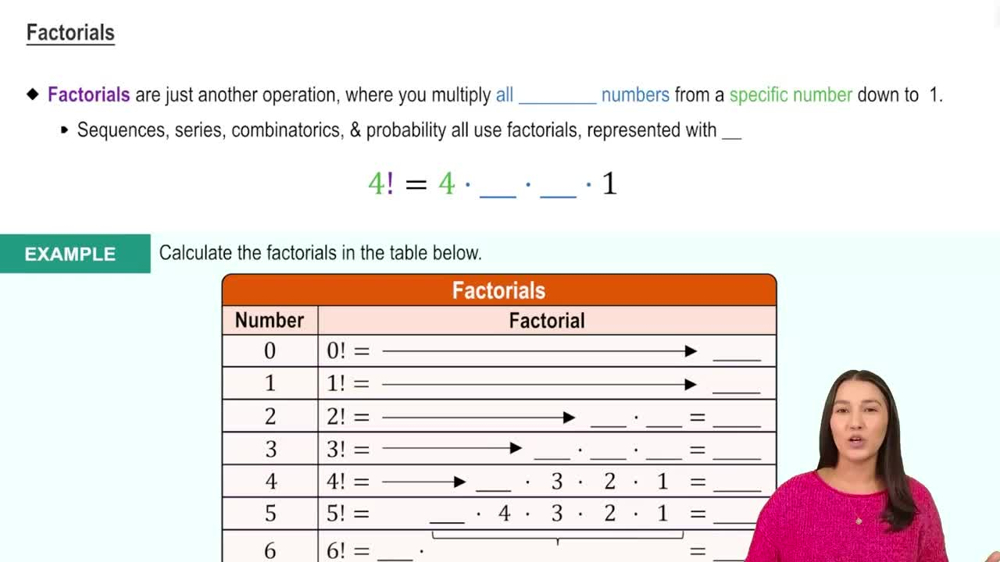
Recall the definition of factorial: for any positive integer \(k\), \(k! = k \times (k-1) \times (k-2) \times \cdots \times 1\).
Write out the factorial expressions explicitly: \((n+2)! = (n+2) \times (n+1) \times n!\).
Substitute this expression into the given fraction: \(\frac{(n+2)!}{n!} = \frac{(n+2) \times (n+1) \times n!}{n!}\).
Cancel the common \(n!\) terms in the numerator and denominator, leaving \(\frac{(n+2) \times (n+1) \times \cancel{n!}}{\cancel{n!}} = (n+2)(n+1)\).
Express the final simplified form as the product of two binomials: \((n+2)(n+1)\), which can be expanded if needed.
Verified video answer for a similar problem:
This video solution was recommended by our tutors as helpful for the problem above
Video duration:
2m
Play a video:
0 Comments
Key Concepts
Here are the essential concepts you must grasp in order to answer the question correctly.
Factorial Notation
Factorial notation, denoted by n!, represents the product of all positive integers from 1 up to n. For example, 5! = 5 × 4 × 3 × 2 × 1 = 120. It is commonly used in permutations, combinations, and algebraic expressions involving sequences.
When simplifying expressions involving factorials, such as (n+2)!/n!, it helps to expand the factorial terms to cancel common factors. For instance, (n+2)! = (n+2)(n+1)n!, so dividing by n! leaves (n+2)(n+1). This technique reduces complex factorial expressions to simpler polynomial forms.
Algebraic manipulation involves applying arithmetic operations and properties of expressions to simplify or solve problems. In factorial expressions, recognizing patterns and factoring common terms allows for efficient simplification and evaluation, which is essential for solving factorial-related exercises.