Ch. 8 - Sequences, Induction, and Probability
Blitzer - College Algebra 8th Edition
Blitzer8th EditionCollege AlgebraISBN: 9780136970514Not the one you use?Change textbook
Chapter 9, Problem 33

Use mathematical induction to prove that each statement is true for every positive integer n. (ab)n = an bn

Verified step by step guidance
1
Step 1: **State the proposition** you want to prove using mathematical induction. Let \( P(n) \) be the statement \( (ab)^n = a^n b^n \) for a positive integer \( n \).
Step 2: **Base case:** Verify that \( P(1) \) is true. Substitute \( n = 1 \) into the statement to check if \( (ab)^1 = a^1 b^1 \) holds.
Step 3: **Inductive hypothesis:** Assume that \( P(k) \) is true for some positive integer \( k \), i.e., assume \( (ab)^k = a^k b^k \).
Step 4: **Inductive step:** Use the inductive hypothesis to prove that \( P(k+1) \) is true. Start with \( (ab)^{k+1} = (ab)^k (ab) \) and then substitute the inductive hypothesis to rewrite it as \( a^k b^k (ab) \).
Step 5: **Simplify the expression** from Step 4 by using the associative and commutative properties of multiplication to show that \( a^k b^k (ab) = a^{k+1} b^{k+1} \), thus proving \( P(k+1) \). Conclude that by mathematical induction, the statement is true for all positive integers \( n \).

Verified video answer for a similar problem:

This video solution was recommended by our tutors as helpful for the problem above.
Video duration:
5m
Was this helpful?

Key Concepts

Here are the essential concepts you must grasp in order to answer the question correctly.

Mathematical Induction

Mathematical induction is a proof technique used to establish that a statement holds for all positive integers. It involves two steps: proving the base case (usually n=1) is true, and then proving that if the statement holds for an arbitrary integer k, it also holds for k+1. This creates a chain of truth for all n.
Recommended video:
Guided course
05:17
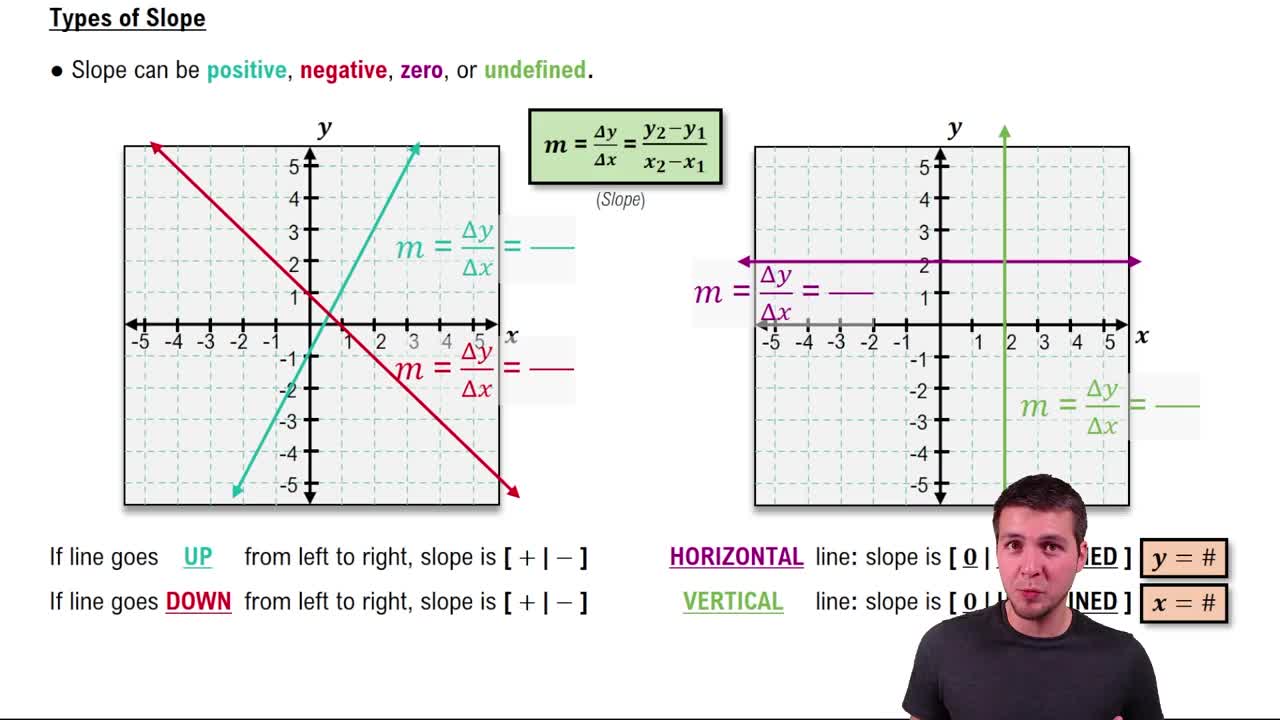
Types of Slope

Properties of Exponents

The properties of exponents describe how to manipulate expressions involving powers. One key property is that (ab)^n = a^n * b^n, meaning the nth power of a product equals the product of the nth powers. Understanding this property is essential to prove the given statement using induction.
Recommended video:
Guided course
04:06
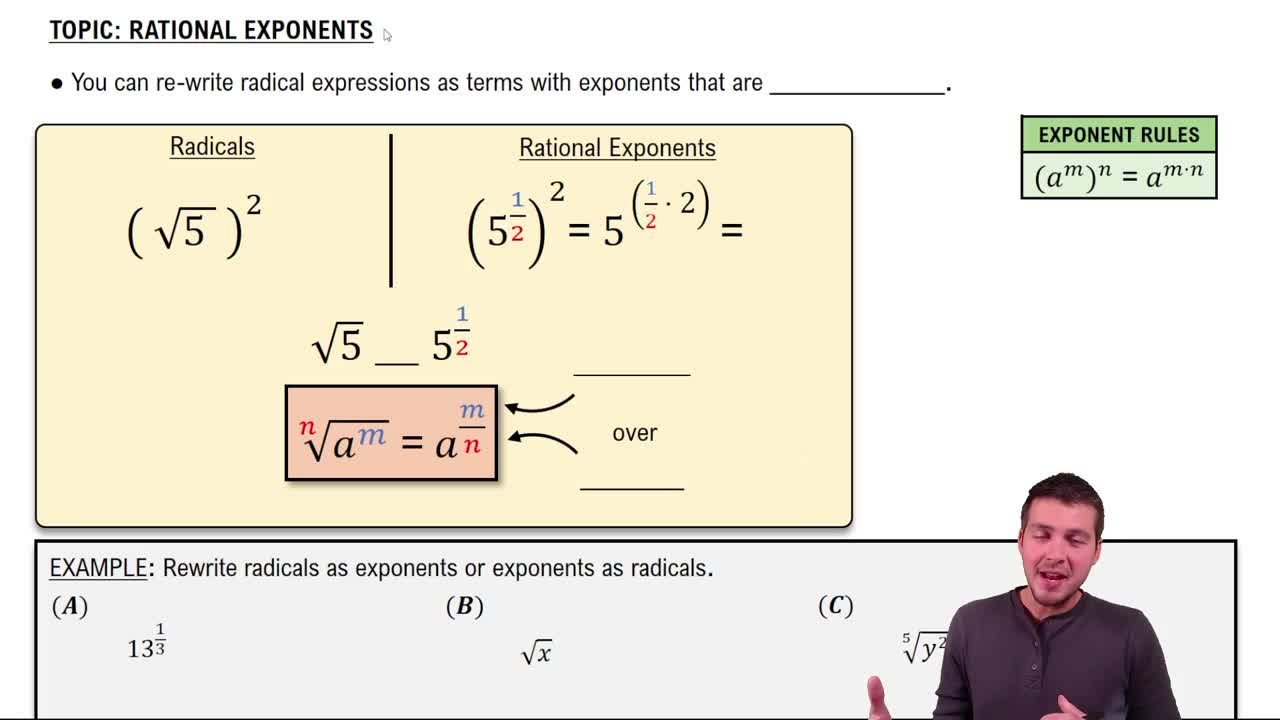
Rational Exponents

Algebraic Manipulation

Algebraic manipulation involves rearranging and simplifying expressions using algebraic rules. In this proof, it is necessary to rewrite (ab)^(k+1) as (ab)^k * (ab) and then apply the induction hypothesis and exponent rules to show equality. Mastery of these skills helps in constructing clear and logical proofs.
Recommended video:
Guided course
05:09
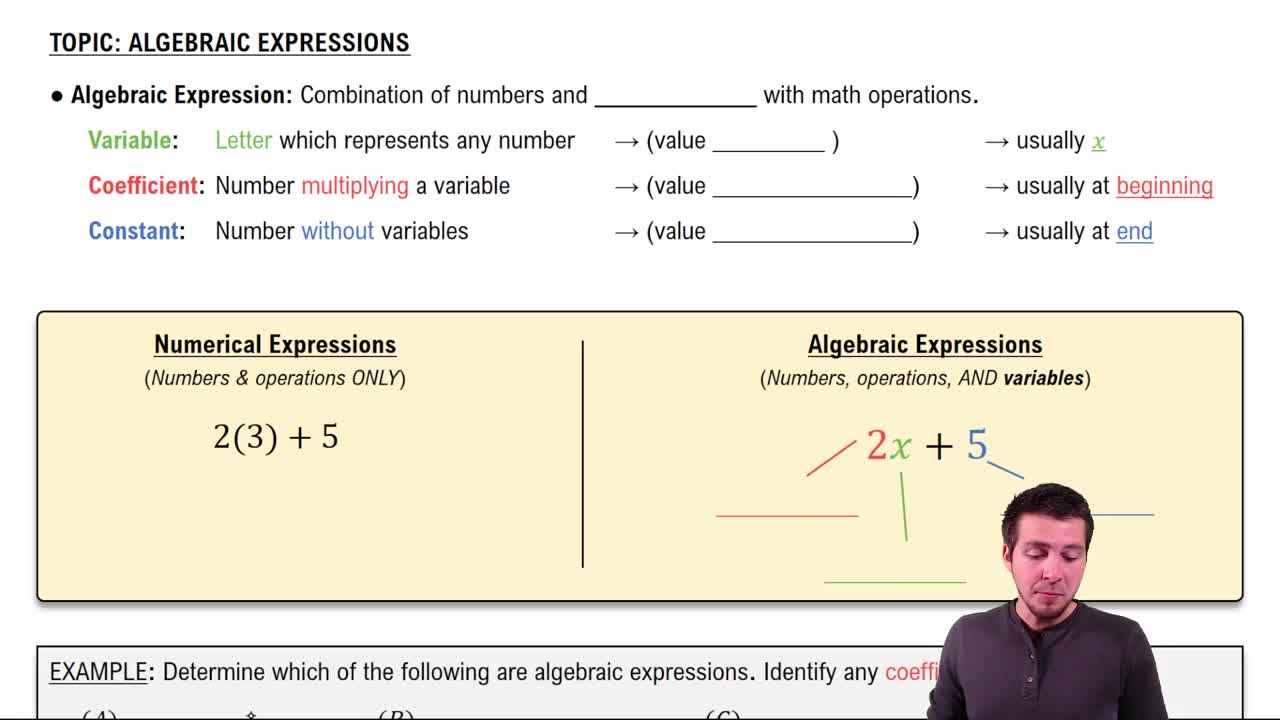
Introduction to Algebraic Expressions