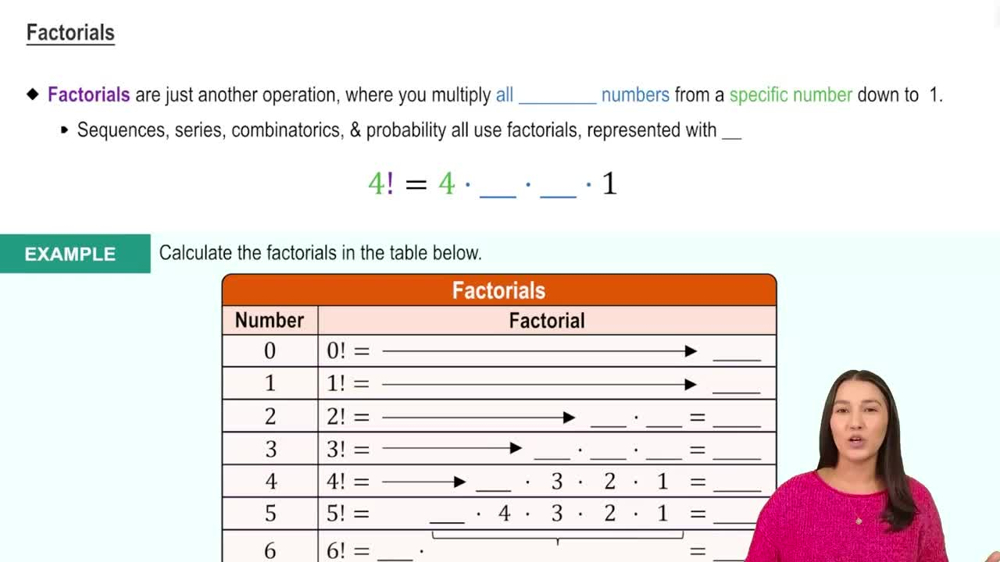
Recall the definition of factorial: for any positive integer \(n\), \(n! = n \times (n-1) \times (n-2) \times \cdots \times 1\).
Rewrite the given expression \(\frac{16!}{2! \times 14!}\) and observe that both numerator and denominator contain factorials that can be simplified.
Express \$16!\( as \(16 \times 15 \times 14!\) to allow cancellation with the \)14!$ in the denominator: \(\frac{16 \times 15 \times 14!}{2! \times 14!}\).
Cancel out the common \$14!$ terms in numerator and denominator, leaving \(\frac{16 \times 15}{2!}\).
Calculate \$2!$ which is \(2 \times 1 = 2\), then simplify the fraction \(\frac{16 \times 15}{2}\) by dividing the numerator by 2.
Verified video answer for a similar problem:
This video solution was recommended by our tutors as helpful for the problem above
Video duration:
2m
Play a video:
0 Comments
Key Concepts
Here are the essential concepts you must grasp in order to answer the question correctly.
Factorial Notation
Factorial notation, denoted by n!, represents the product of all positive integers from 1 up to n. For example, 5! = 5 × 4 × 3 × 2 × 1 = 120. It is commonly used in permutations, combinations, and algebraic expressions.
When factorials appear in fractions, common terms can be canceled to simplify the expression. For instance, in 16!/2!14!, the 14! in the denominator cancels with part of 16! in the numerator, reducing the calculation to a simpler product.
After simplification, evaluate the remaining factorial terms by multiplying the integers. This step involves careful arithmetic to find the numerical value of the expression, ensuring accuracy in the final result.