
Textbook Question
In Exercises 17–20, you are dealt one card from a standard 52-card deck. Find the probability of being dealt a picture card.
614
views

 Verified step by step guidance
 4:45
4:45
 5:22 5:22
In Exercises 17–20, you are dealt one card from a standard 52-card deck. Find the probability of being dealt a picture card.
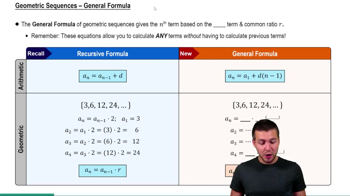
Write a formula for the general term (the nth term) of each geometric sequence. Then use the formula for an to find a7, the seventh term of the sequence. 18, 6, 2, 2/3, ...
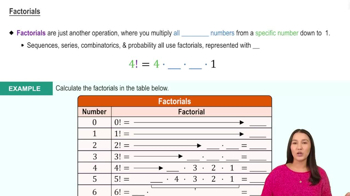
In Exercises 19–22, the general term of a sequence is given and involves a factorial. Write the first four terms of each sequence. a_n=(n+1)!/n^2
Find the indicated term of the arithmetic sequence with first term, and common difference, d. Find a200 when a1 = −40, d = 5.
Use mathematical induction to prove that each statement is true for every positive integer n. 2 + 4 + 8 + ... + 2n = 2n+1 - 2
Write a formula for the general term (the nth term) of each arithmetic sequence. Do not use a recursion formula. Then use the formula for an to find a20, the 20th term of the sequence. -7, -3, 1, 5 ...