Ch. 8 - Sequences, Induction, and Probability
Blitzer - College Algebra 8th Edition
Blitzer8th EditionCollege AlgebraISBN: 9780136970514Not the one you use?Change textbook
Chapter 9, Problem 9

Write the first four terms of each sequence whose general term is given. an=2n/(n+4)

Verified step by step guidance
1
Identify the general term of the sequence given by \(a_n = \frac{2n}{n+4}\), where \(n\) represents the term number.
Calculate the first term by substituting \(n=1\) into the formula: \(a_1 = \frac{2(1)}{1+4}\).
Calculate the second term by substituting \(n=2\) into the formula: \(a_2 = \frac{2(2)}{2+4}\).
Calculate the third term by substituting \(n=3\) into the formula: \(a_3 = \frac{2(3)}{3+4}\).
Calculate the fourth term by substituting \(n=4\) into the formula: \(a_4 = \frac{2(4)}{4+4}\).

Verified video answer for a similar problem:

This video solution was recommended by our tutors as helpful for the problem above.
Video duration:
2m
Was this helpful?

Key Concepts

Here are the essential concepts you must grasp in order to answer the question correctly.

Sequences and Terms

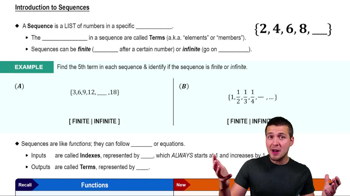
A sequence is an ordered list of numbers defined by a specific rule or formula. Each number in the sequence is called a term, and the position of a term is indicated by its index n. Understanding how to identify and write terms from a general formula is fundamental.
Recommended video:
Guided course
8:22
Introduction to Sequences

General Term Formula

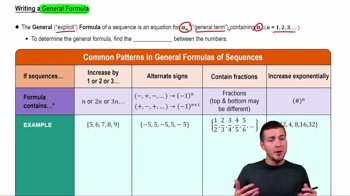
The general term formula, an, expresses the nth term of a sequence as a function of n. By substituting different values of n (usually positive integers), you can find specific terms in the sequence. This formula allows you to generate any term without listing all previous terms.
Recommended video:
Guided course
7:17
Writing a General Formula

Substitution and Simplification

To find terms of a sequence from the general term, substitute values of n into the formula and simplify the expression. This involves basic algebraic manipulation such as fraction simplification and arithmetic operations to obtain the numerical value of each term.
Recommended video:
Guided course
5:48
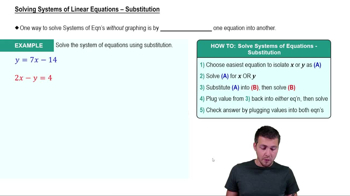
Solving Systems of Equations - Substitution