Ch. 8 - Sequences, Induction, and Probability
Blitzer - College Algebra 8th Edition
Blitzer8th EditionCollege AlgebraISBN: 9780136970514Not the one you use?Change textbook
Chapter 9, Problem 10

In Exercises 10–11, express each sum using summation notation. Use i for the index of summation. 1/3 + 2/4 + 3/5 + ... + 15/17

Verified step by step guidance
1
Step 1: Identify the general term of the sequence. Observe the pattern in the numerators and denominators of the fractions: the numerator increases by 1 starting from 1, and the denominator increases by 1 starting from 3. The general term can be expressed as ii+2, where i is the index of summation.
Step 2: Determine the range of the index of summation. The sequence starts with the fraction 13 (when i = 1) and ends with the fraction 1517 (when i = 15). Therefore, the index i ranges from 1 to 15.
Step 3: Write the summation notation. Combine the general term and the range of the index to express the sum in summation notation: i115ii+2.
Step 4: Verify the summation notation. Check that the general term and the range of the index correctly represent the given sequence. Substitute a few values of i (e.g., i = 1, i = 2, i = 15) into the summation notation to confirm that it matches the original sequence.
Step 5: Finalize the summation notation. The sum can now be expressed as i115ii+2, which represents the sequence 1/3 + 2/4 + 3/5 + ... + 15/17.

Verified video answer for a similar problem:

This video solution was recommended by our tutors as helpful for the problem above.
Video duration:
2m
Was this helpful?

Key Concepts

Here are the essential concepts you must grasp in order to answer the question correctly.

Summation Notation

Summation notation is a mathematical shorthand used to represent the sum of a sequence of terms. It is typically denoted by the Greek letter sigma (Σ), followed by an expression that defines the terms to be summed, along with limits that specify the starting and ending indices. For example, Σ from i=1 to n of a_i indicates the sum of the terms a_1, a_2, ..., a_n.
Recommended video:
05:18
Interval Notation

Index of Summation

The index of summation is a variable that represents the position of each term in the sequence being summed. In the expression Σ from i=a to b of f(i), 'i' is the index that takes on integer values from 'a' to 'b'. This index allows us to systematically enumerate each term in the sum, making it easier to express complex series in a concise form.
Recommended video:
Guided course
03:50
Adding & Subtracting Like Radicals

Arithmetic Sequences

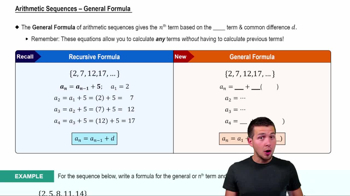
An arithmetic sequence is a sequence of numbers in which the difference between consecutive terms is constant. In the given sum, the numerators (1, 2, 3, ..., 15) form a simple arithmetic sequence where each term increases by 1. Understanding the properties of arithmetic sequences is essential for identifying patterns and expressing sums in summation notation.
Recommended video:
Guided course
5:17
Arithmetic Sequences - General Formula