Ch. 8 - Sequences, Induction, and Probability
Blitzer - College Algebra 8th Edition
Blitzer8th EditionCollege AlgebraISBN: 9780136970514Not the one you use?Change textbook
Chapter 9, Problem 19

Use mathematical induction to prove that each statement is true for every positive integer n. 2 + 4 + 8 + ... + 2n = 2n+1 - 2

Verified step by step guidance
1
Step 1: Understand the statement to prove by induction. We want to prove that for every positive integer \(n\), the sum \(2 + 4 + 8 + \dots + 2^{n}\) equals \$2^{n+1} - 2$.
Step 2: Base Case - Verify the statement for \(n=1\). Substitute \(n=1\) into both sides: Left side is \$2^{1} = 2\(, and right side is \)2^{1+1} - 2 = 2^{2} - 2 = 4 - 2 = 2$. Since both sides are equal, the base case holds.
Step 3: Inductive Hypothesis - Assume the statement is true for some positive integer \(k\), that is, assume \(2 + 4 + 8 + \dots + 2^{k} = 2^{k+1} - 2\).
Step 4: Inductive Step - Using the inductive hypothesis, prove the statement for \(k+1\). Start with the sum up to \(k+1\): \(2 + 4 + 8 + \dots + 2^{k} + 2^{k+1}\). Replace the sum up to \(k\) using the hypothesis: \(\left(2^{k+1} - 2\right) + 2^{k+1}\).
Step 5: Simplify the expression from Step 4: Combine like terms to get \(2^{k+1} - 2 + 2^{k+1} = 2 \times 2^{k+1} - 2 = 2^{k+2} - 2\). This matches the right side of the statement for \(n = k+1\), completing the inductive step.

Verified video answer for a similar problem:

This video solution was recommended by our tutors as helpful for the problem above.
Video duration:
7m
Was this helpful?

Key Concepts

Here are the essential concepts you must grasp in order to answer the question correctly.

Mathematical Induction

Mathematical induction is a proof technique used to verify statements for all positive integers. It involves two steps: proving the base case (usually n=1) is true, and then showing that if the statement holds for an arbitrary integer k, it also holds for k+1. This method establishes the truth of the statement for all n.
Recommended video:
Guided course
05:17
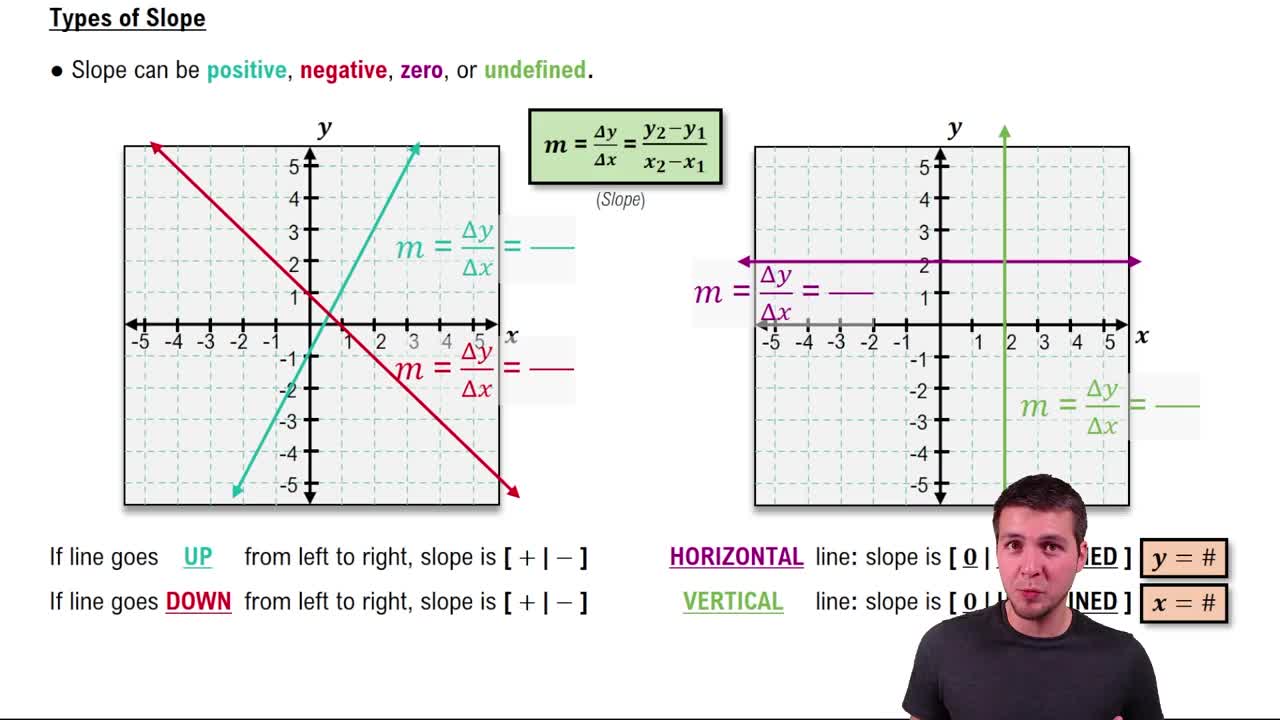
Types of Slope

Geometric Series

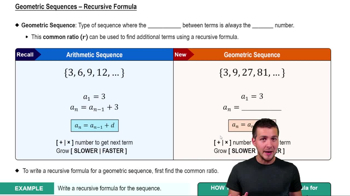
A geometric series is a sum of terms where each term is found by multiplying the previous term by a constant ratio. In this problem, the series 2 + 4 + 8 + ... + 2^n is geometric with ratio 2. Understanding the formula for the sum of a geometric series helps in recognizing and proving the given expression.
Recommended video:
Guided course
4:18
Geometric Sequences - Recursive Formula

Exponents and Powers of Two

Exponents represent repeated multiplication of a base number. Powers of two, like 2^n, grow exponentially and are common in algebraic expressions. Familiarity with exponent rules is essential to manipulate and simplify terms like 2^(n+1) and to understand the structure of the series.
Recommended video:
04:10
Powers of i