Ch. 8 - Sequences, Induction, and Probability
Blitzer - College Algebra 8th Edition
Blitzer8th EditionCollege AlgebraISBN: 9780136970514Not the one you use?Change textbook
Chapter 9, Problem 57

Express each sum using summation notation. Use a lower limit of summation of your choice and k for the index of summation. a+ar+ar2+⋯+ ar12

Verified step by step guidance
1
Identify the pattern of the terms in the sum: the first term is \( a \), the second term is \( ar \), the third term is \( ar^2 \), and so on, up to \( ar^{12} \).
Recognize that this is a geometric series where each term is obtained by multiplying the previous term by \( r \). The general term can be written as \( ar^k \) where \( k \) is the exponent of \( r \).
Choose the index of summation \( k \) to start at 0, since the first term corresponds to \( r^0 = 1 \). So, the lower limit of summation is \( k = 0 \).
Determine the upper limit of summation. Since the last term is \( ar^{12} \), the upper limit is \( k = 12 \).
Write the sum in summation notation as: \[ \sum_{k=0}^{12} a r^k \]

Verified video answer for a similar problem:

This video solution was recommended by our tutors as helpful for the problem above.
Video duration:
2m
Was this helpful?

Key Concepts

Here are the essential concepts you must grasp in order to answer the question correctly.

Summation Notation

Summation notation is a concise way to represent the sum of a sequence of terms using the sigma symbol (∑). It includes an index of summation, lower and upper limits, and a general term formula. This notation simplifies writing long sums and helps in analyzing series.
Recommended video:
05:18
Interval Notation

Geometric Series

A geometric series is a sum of terms where each term is found by multiplying the previous term by a constant ratio r. The general form is a + ar + ar² + ... + ar^n. Recognizing this pattern helps in expressing the sum compactly and finding closed-form formulas.
Recommended video:
Guided course
4:18
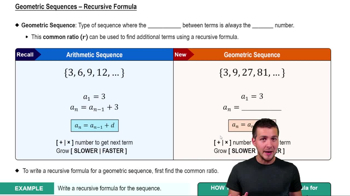
Geometric Sequences - Recursive Formula

Index of Summation and Limits

The index of summation (commonly k) represents the variable that changes in each term of the sum. The lower and upper limits define the starting and ending values of this index. Choosing appropriate limits is essential for accurately representing the sum in summation notation.
Recommended video:
Guided course
03:50
Adding & Subtracting Like Radicals