
Textbook Question
The myocardium receives its blood supply directly from the:
a. Aorta
b. Coronary arteries
c. Coronary sinus
d. Pulmonary arteries
1462
views

 Verified step by step guidance
 3:20
3:20
 13:34
13:34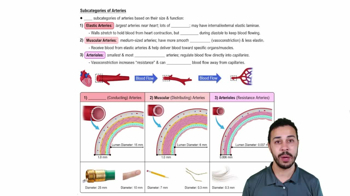 14:43
14:43The myocardium receives its blood supply directly from the:
a. Aorta
b. Coronary arteries
c. Coronary sinus
d. Pulmonary arteries
Tracing the blood from the heart to the right hand, we find that blood leaves the heart and passes through the aorta, the right subclavian artery, the axillary and brachial arteries, and through either the radial or ulnar artery to arrive at the hand. Which artery is missing from this sequence?
a. Coronary
b. Brachiocephalic
c. Cephalic
d. Right common carotid
Blood flow in the capillaries is steady despite the rhythmic pumping of the heart because of the:
a. Elasticity of the large arteries
b. Small diameter of capillaries
c. Thin walls of the veins
d. Venous valves
How is the anatomy of capillaries and capillary beds well suited to their function?
a. Define blood pressure. Differentiate between systolic and diastolic blood pressure.
b. What is the normal blood pressure value for an adult?
The baroreceptors in the carotid sinus and aortic arch are sensitive to
a. a decrease in CO₂
b. changes in arterial pressure
c. a decrease in O₂
d. all of these