
Textbook Question
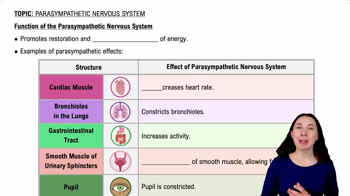
As the aroma of freshly brewed coffee drifted by dozing Henry's nose, his mouth started to water and his stomach began to rumble. Explain his reactions in terms of ANS activity.
789
views

 Verified step by step guidance
 03:53
03:53
 1:56
1:56 1:32
1:32As the aroma of freshly brewed coffee drifted by dozing Henry's nose, his mouth started to water and his stomach began to rumble. Explain his reactions in terms of ANS activity.
Describe the importance of the hypothalamus in controlling the autonomic nervous system.
Tiffany, a 21-year-old college student, is having trouble sleeping, cries frequently, and has recurrent thoughts of suicide. An antidepressant is prescribed. Like many such drugs, this antidepressant has anticholinergic side effects. What side effects might Tiffany experience in the first week of treatment?
A reflex that causes reciprocal activation of the antagonist muscle is the
a. Crossed-extensor
b. Flexor
c. Tendon
d. Muscle stretch
A 32-year-old woman complains of intermittent aching pains in the medial two fingers of both hands. During such episodes, the fingers become blanched and then blue. Her history is taken, and it is noted that she is a heavy smoker. The physician advises her that she must stop smoking and states that she will not prescribe any medication until the patient has discontinued smoking for a month. What is this patient's condition, and why was she told to stop smoking?